Estimating Operational Costs of Activated Carbon for Water Treatment Plants by Predicting the Rise of Harmful Algal Blooms Under Climate Change in Korea Using Machine Learning
Jayun Kim, Himchan Park, John J. Lenhart, Jiyoung Lee, Kendall Byrd, Gayeon Jang, Sangjun Kim, Joonhong Park

TL;DR
This study uses machine learning to predict how climate change will increase harmful algal blooms in South Korea and raise water treatment costs.
Contribution
A novel method combining machine learning and cost analysis to estimate future water treatment expenses due to climate-driven algal blooms.
Findings
Cyanobacteria density is projected to increase 3–5 times by 2100 under the SSP5–8.5 climate scenario.
Water treatment costs could triple, reaching $22.1/month/household by 2100 due to higher PAC usage.
Proactive measures are needed to address rising health risks and treatment burdens from algal blooms.
Abstract
The escalating frequency of harmful cyanobacterial blooms (HCBs), driven by climate change and eutrophication, poses risks to ecosystems, water resources, and public health. Given South Korea's heavy reliance on surface waters, increasingly affected by HCBs producing microcystins and taste and odor compounds (geosmin and 2‐methylisoborneol), this study used machine learning to predict cyanobacterial proliferation by 2100 under climate scenarios. It also estimates increases in treatment costs, assuming water treatment plants (WTPs) respond to increased bloom intensity solely by modifying their usage of powdered activated carbon (PAC). A random forest (RF) model trained on 28 years of Nakdong River data projected HCB occurrences under Shared Socioeconomic Pathway 5–8.5. The RF indicated significant increases in HCB magnitude and variability (cyanobacteria densities from 1.6 × 10⁴ to 6.3 ×…
Genes, proteins, chemicals, diseases, species, mutations and cell lines named across the full text — each resolved to its canonical identifier and authoritative record.
Click any figure to enlarge with its caption.
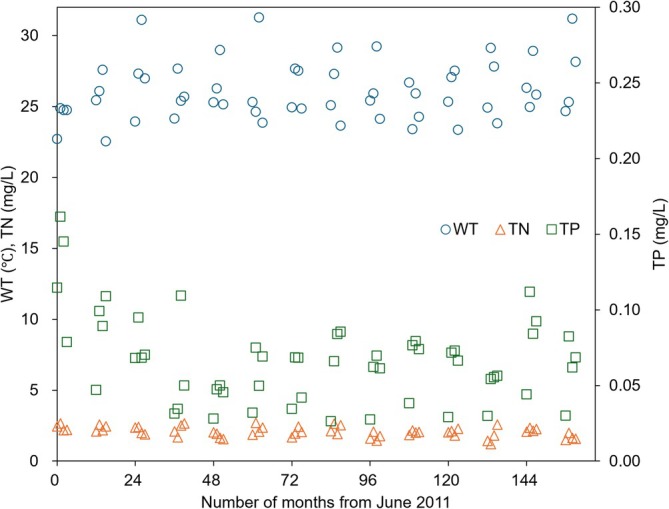 Figure 1
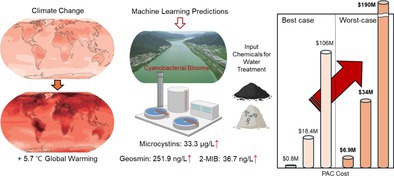 Figure 2
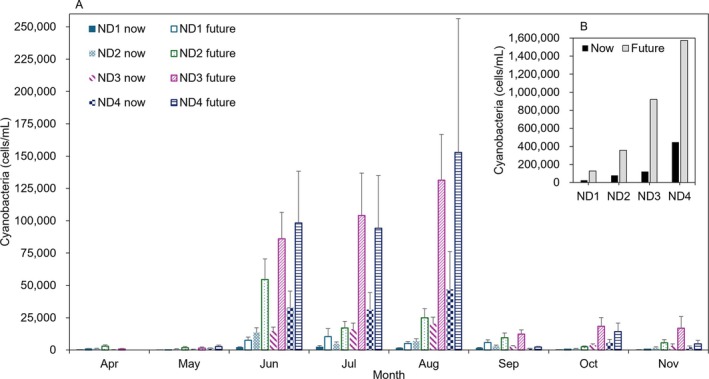 Figure 3
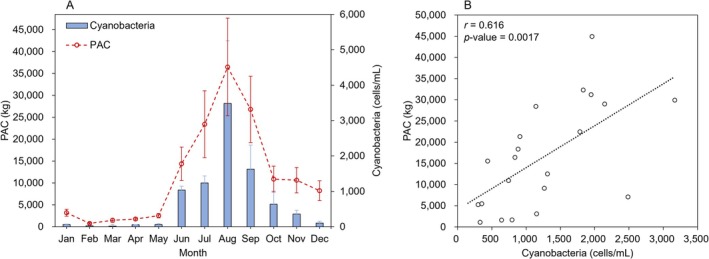 Figure 4
 Figure 5
 Figure 6
 Figure 7
 Figure 8
Peer Reviews
No public reviews on file for this paper yet. If you reviewed it on a platform where reviews are public (OpenReview, ICLR, NeurIPS, ICML), you can paste yours below so the community can read it here.
Videos
No videos yet. Explain this paper in a talk, walkthrough, or lecture? Add one.
Taxonomy
TopicsAquatic Ecosystems and Phytoplankton Dynamics · Constructed Wetlands for Wastewater Treatment · Freshwater macroinvertebrate diversity and ecology