Polychlorinated biphenyls and breast cancer: evidence, mechanisms, and risk management
Shuaiyang Zhang, Hongliang Cao, Runzhou Lian, Ying Liu, Yuting Zhu, Xinxin Gui, Tianzi Kong, Aiping Shi

TL;DR
This paper explores how polychlorinated biphenyls (PCBs) may actively contribute to breast cancer development and suggests new ways to manage the associated risks.
Contribution
The paper proposes that PCBs act as active drivers of breast cancer through a metabolic-oxidative-epigenetic mechanism, rather than just being passive exposure markers.
Findings
PCBs accumulate in adipose tissue, prolonging their toxic effects over a person's lifetime.
PCBs trigger mitochondrial dysfunction and epigenetic changes by interacting with AhR and ER receptors.
Different PCB subtypes may drive distinct breast cancer subtypes through specific mechanisms.
Abstract
Epidemiological inconsistencies currently obscure the causal link between polychlorinated biphenyls (PCBs) and breast cancer. This review synthesizes multi-disciplinary evidence to characterize PCBs not as passive exposure correlates but as active drivers of tumorigenesis via a metabolic–oxidative–epigenetic axis. We examine how lipophilic congeners accumulate in adipose reservoirs, extending toxicity across the life course beyond distinct susceptibility windows. Mechanistically, receptor crosstalk between the aryl hydrocarbon receptor (AhR) and the estrogen receptor (ER) triggers mitochondrial dysfunction and inhibits ten–eleven translocation (TET) enzyme activity, creating an oxidative state that establishes epigenetic locking of tumor suppressor genes. We propose subtype-specific evolutionary trajectories: postulating that dioxin-like congeners drive AhR-mediated stemness in…
Genes, proteins, chemicals, diseases, species, mutations and cell lines named across the full text — each resolved to its canonical identifier and authoritative record.
Click any figure to enlarge with its caption.
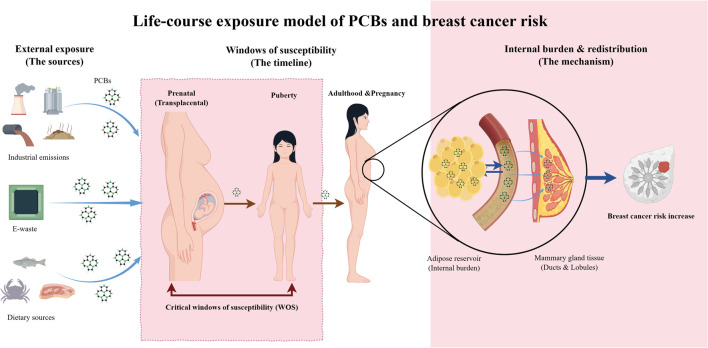 Figure 1
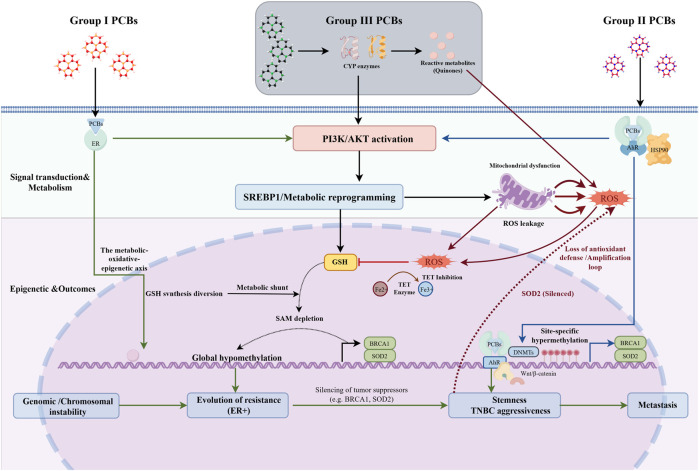 Figure 2
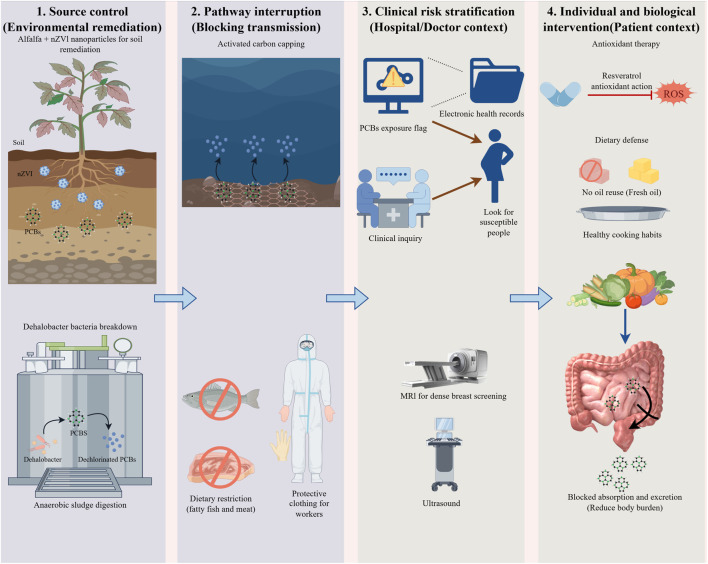 Figure 3
Peer Reviews
No public reviews on file for this paper yet. If you reviewed it on a platform where reviews are public (OpenReview, ICLR, NeurIPS, ICML), you can paste yours below so the community can read it here.
Videos
No videos yet. Explain this paper in a talk, walkthrough, or lecture? Add one.
Taxonomy
TopicsToxic Organic Pollutants Impact · Effects and risks of endocrine disrupting chemicals · Carcinogens and Genotoxicity Assessment