Prioritizing vaginal hysterectomy: a stepped algorithm with vNOTES support for benign indications
Sezin Eda Karsli, Yusuf Ziya Kizildemir, Sibel Sak, Muhammed Erdal Sak, Hacer Uyanikoglu, Mehmet Incebiyik, Helin Kalir, Işil Işik Okuyan, Merve Civelek, Cagri Kutlugun Emral, Bekir Kahveci

TL;DR
This study shows a vaginal-first surgical approach for benign gynecological conditions achieves high success rates, with vNOTES serving as a helpful bridge and safety measure.
Contribution
Introduces a standardized vaginal-first surgical algorithm with vNOTES as an educational and safety tool for benign hysterectomies.
Findings
Vaginal hysterectomy was successful in 87.9% of cases without abdominal incision.
vNOTES was used in 7.3% of cases as a transitional method.
Uterine weight was the only independent predictor of vaginal hysterectomy failure.
Abstract
This prospective study aimed to evaluate the clinical outcomes of a standardized surgical algorithm adopting a “vaginal-first” approach in patients with non-descensus uteri. It sought to redefine vNOTES as an “educational bridge” and a “safety valve” within this framework. This single-center, prospective cohort study included 165 consecutive patients scheduled for hysterectomy for benign indications. A standardized stepwise algorithm was implemented: pure vaginal hysterectomy (VH) as the primary target; transition to vNOTES (second tier) in case of failure to progress; and laparoscopy or laparotomy as a final resort. All procedures were performed by a single surgeon. Vaginal completion without abdominal incision was achieved in 157 patients (95.2%). Pure VH was successful in 87.9% (n = 145), while 7.3% (n = 12) required vNOTES support, and 4.8% (n = 8) were converted to…
Genes, proteins, chemicals, diseases, species, mutations and cell lines named across the full text — each resolved to its canonical identifier and authoritative record.
Click any figure to enlarge with its caption.
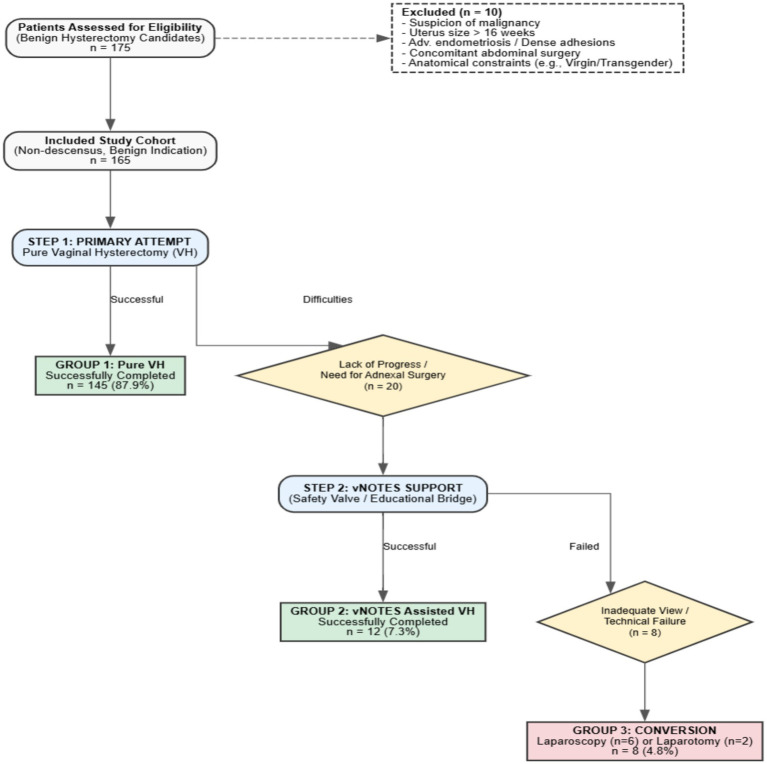 Figure 1
Peer Reviews
No public reviews on file for this paper yet. If you reviewed it on a platform where reviews are public (OpenReview, ICLR, NeurIPS, ICML), you can paste yours below so the community can read it here.
Videos
No videos yet. Explain this paper in a talk, walkthrough, or lecture? Add one.
Taxonomy
TopicsUterine Myomas and Treatments · Gynecological conditions and treatments · Maternal and fetal healthcare