From response-to-routine: embedding humanitarian supply evaluation in Singapore's health and community care systems
Huay Ling Tay, Chuan De Foo

TL;DR
This paper proposes integrating humanitarian supply evaluation into Singapore's healthcare to improve resilience, equity, and sustainability amid aging and climate risks.
Contribution
The paper introduces a 'Response-to-Routine' framework for embedding humanitarian principles into public health systems.
Findings
A four-dimensional framework is proposed to enhance healthcare resilience and equity.
Scenario-based stress testing and community integration are recommended for policy implementation.
Institutionalizing resilience audits can improve preparedness for vulnerable populations.
Abstract
Singapore's ageing population and exposure to climate-related and pandemic risks demand a health system that is not only efficient but also inherently resilient to shocks and equitable in health service delivery. Policies need to address the current supply chain evaluations in public health to focus on cost and speed of healthcare delivery to close critical gaps in preparedness during times of sudden disruptions. Embedding a humanitarian perspective in public healthcare systems provides frameworks for resilience, equity, and sustainability. Yet these principles remain siloed from routine health governance. This policy brief argues for embedding humanitarian supply evaluation into Singapore's health and community care systems through a “Response-to-Routine” paradigm. We propose an implementable four-dimensional framework: Resilience & Equity, Climate & Sustainability, Governance &…
Click any figure to enlarge with its caption.
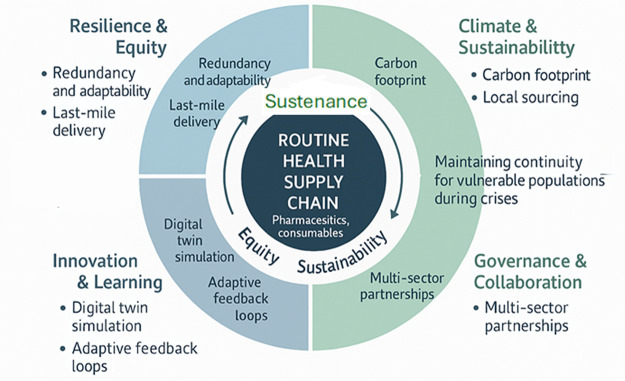 Figure 1
Peer Reviews
No public reviews on file for this paper yet. If you reviewed it on a platform where reviews are public (OpenReview, ICLR, NeurIPS, ICML), you can paste yours below so the community can read it here.
Videos
No videos yet. Explain this paper in a talk, walkthrough, or lecture? Add one.
Taxonomy
TopicsDisaster Response and Management · Viral Infections and Outbreaks Research · Climate Change and Health Impacts