Recursion beyond language: Lexical and arithmetic interference in visual hierarchical embedding
Mauricio J.D. Martins, Daniel J. Cook, Arno Villringer

TL;DR
The study explores how humans process visual hierarchies, finding that recursion is more resilient than iteration when cognitive resources are taxed.
Contribution
The paper introduces a dual-task paradigm to show that visual recursion relies on symbolic resources but can flexibly compensate under interference.
Findings
Lexical retrieval and arithmetic impaired both visual recursion and iteration tasks.
Drift diffusion modeling revealed symbolic interference reduced evidence accumulation and decision thresholds.
Visual recursion outperformed iteration in accuracy under interference, suggesting compensatory strategies.
Abstract
The capacity to represent recursive hierarchical embedding (RHE) is considered a hallmark of human cognition. Yet, it remains debated whether non-linguistic recursion depends on language-specific, domain-general, or independent visuospatial mechanisms. In two experiments, we tested this question using a dual-task paradigm. Participants performed either a visual recursion task (REC) or a matched visual iteration task (ITE) while concurrently engaging in lexical retrieval (LEX), serial arithmetic (MATH), visual delayed match-to-sample (VIS), or no interference (NONE). Both LEX and MATH—tasks that require serial, symbolic, generative processing—reliably reduced accuracy in REC and ITE, with interference being stronger for ITE. Drift diffusion modeling confirmed that LEX and MATH slowed evidence accumulation and reduced decision thresholds, indicating less efficient and more impulsive…
Genes, proteins, chemicals, diseases, species, mutations and cell lines named across the full text — each resolved to its canonical identifier and authoritative record.
Click any figure to enlarge with its caption.
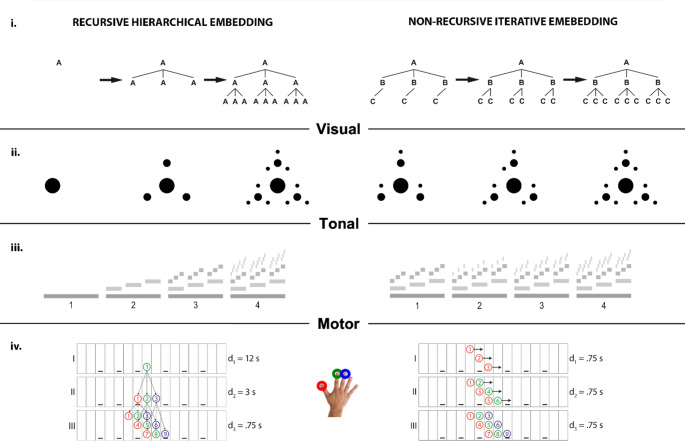 Figure 1
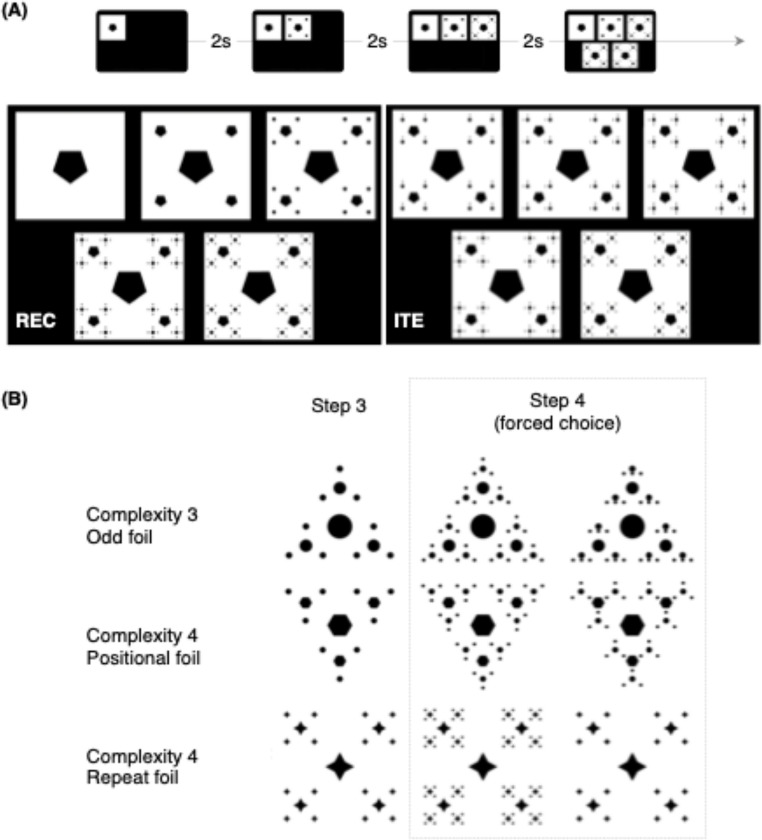 Figure 2
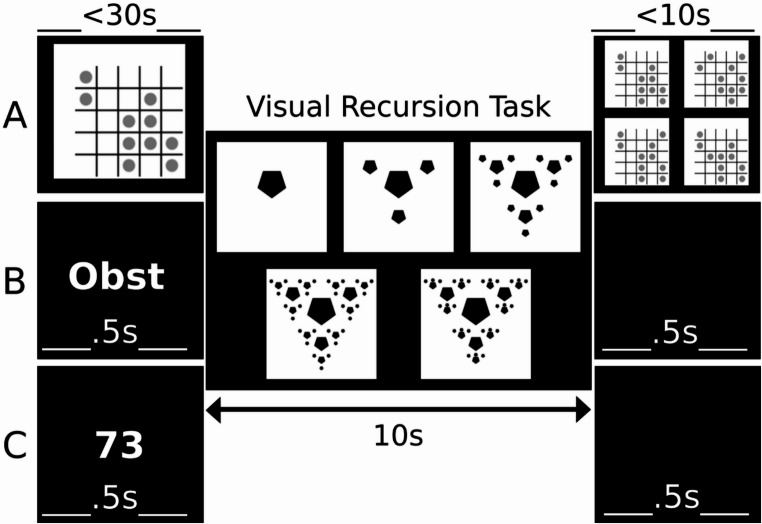 Figure 3
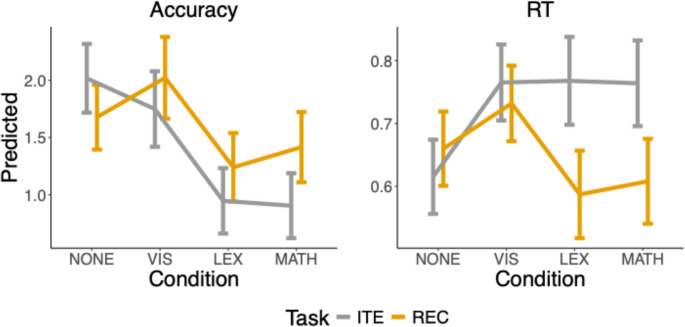 Figure 4
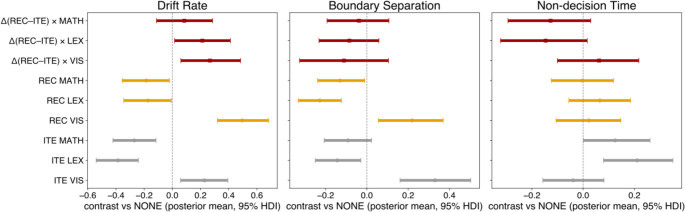 Figure 5
 Figure 6
Peer Reviews
No public reviews on file for this paper yet. If you reviewed it on a platform where reviews are public (OpenReview, ICLR, NeurIPS, ICML), you can paste yours below so the community can read it here.
Videos
No videos yet. Explain this paper in a talk, walkthrough, or lecture? Add one.
Taxonomy
TopicsNeurobiology of Language and Bilingualism · Cognitive and developmental aspects of mathematical skills · Action Observation and Synchronization