Space–time clustering of childhood high hyperdiploid B-cell precursor acute lymphoblastic leukemia: a nationwide Swedish study
Gleb Bychkov, Niklas Engsner, Benedicte Bang, Mats Marshall Heyman, Gisela Barbany, Anna Skarin Nordenvall, Giorgio Tettamanti, Claes Strannegård, Ann Nordgren

TL;DR
This study found that a specific genetic subtype of childhood leukemia in Sweden shows space-time clustering, suggesting possible environmental or infectious causes.
Contribution
The study is the first to examine space-time clustering in childhood ALL by genetic subtype, revealing clustering in high hyperdiploid cases.
Findings
High hyperdiploid BCP-ALL cases showed significant space-time clustering at birth and diagnosis.
No clustering was observed in other ALL subtypes like T-ALL or ETV6::RUNX1.
Findings suggest etiologic differences in BCP-ALL subtypes, warranting further research on environmental factors.
Abstract
Acute lymphoblastic leukemia (ALL) is the most common childhood malignancy. While space–time clustering of ALL cases has been suggested, only one prior study has examined clustering by genetic subtype. We investigated space–time clustering of childhood ALL in Sweden, both overall and by genetic subtype. The cohort included 1,629 children age 0–18 years diagnosed with ALL between 1992 and 2017, comprising 1,446 B-cell precursor ALL (BCP-ALL) and 183 T-cell ALL (T-ALL) cases. Two BCP-ALL subgroups were analyzed: high hyperdiploidy (HeH, n = 466) and ETV6::RUNX1 (n = 225). The Unbiased Knox Test and Unbiased Combined Knox Test were used to assess space–time clustering at the municipality level, accounting for multiple testing and population shifts. The Density-Based Spatial Clustering of Applications with Noise (DBSCAN) algorithm was applied to identify significant clusters. Logistic…
Genes, proteins, chemicals, diseases, species, mutations and cell lines named across the full text — each resolved to its canonical identifier and authoritative record.
Click any figure to enlarge with its caption.
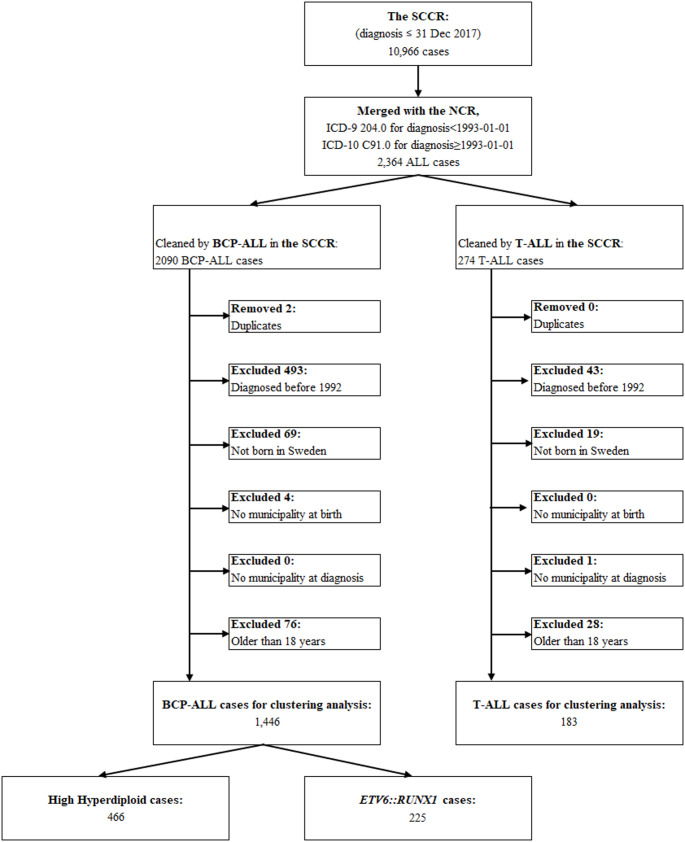 Figure 1
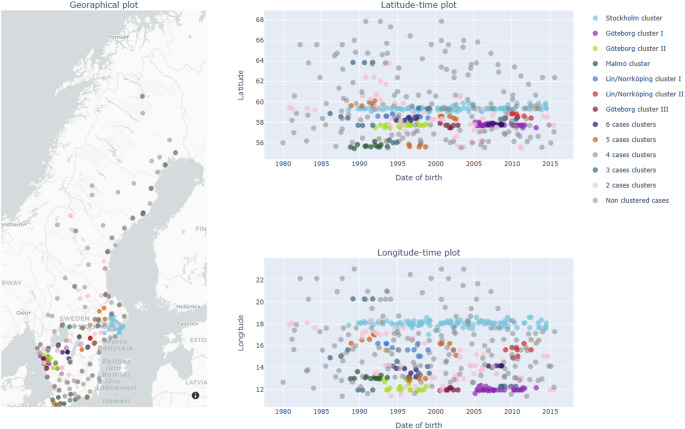 Figure 2
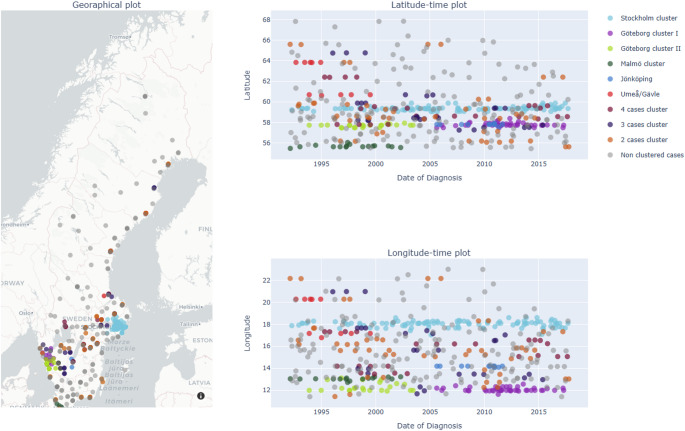 Figure 3
Peer Reviews
No public reviews on file for this paper yet. If you reviewed it on a platform where reviews are public (OpenReview, ICLR, NeurIPS, ICML), you can paste yours below so the community can read it here.
Videos
No videos yet. Explain this paper in a talk, walkthrough, or lecture? Add one.
Taxonomy
TopicsAcute Lymphoblastic Leukemia research · Chronic Myeloid Leukemia Treatments · Lymphoma Diagnosis and Treatment