Adenoviruses found in bats of southwestern Texas
Jadance L. Black, Alexandra Moya, Matt J. Van Sant, Dana N. Lee

TL;DR
Researchers found new adenovirus sequences in bat fecal samples from Texas, which are distinct from known adenoviruses.
Contribution
The study reports novel adenovirus sequences from bats in Texas that are phylogenetically distinct from known adenoviruses.
Findings
Three bat samples from Antrozous pallidus had identical adenovirus sequences.
The sequences differed by more than 12% from any currently classified adenoviruses.
The sequences were most similar to an adenovirus previously found in Myotis velifer.
Abstract
Few studies have examined adenoviruses (AdVs) in bats from the U.S.; therefore, we targeted a fragment of the adenoviral DNA polymerase gene from 94 fecal samples from nine bat species in Texas. Three samples from Antrozous pallidus had identical sequences, but these differed from those found in one Myotis yumanensis and one Tadarida brasiliensis sample. Phylogenetic analysis showed that these DNA sequences were most similar to those of a previously described AdV found in Myotis velifer in Oklahoma. Each of these sequences differed by more than > 12% from those of any currently classified AdVs and by more than 10% from that of a currently unclassified AdV isolate from Myotis myotis. The online version contains supplementary material available at 10.1007/s00705-025-06499-9.
Genes, proteins, chemicals, diseases, species, mutations and cell lines named across the full text — each resolved to its canonical identifier and authoritative record.
Click any figure to enlarge with its caption.
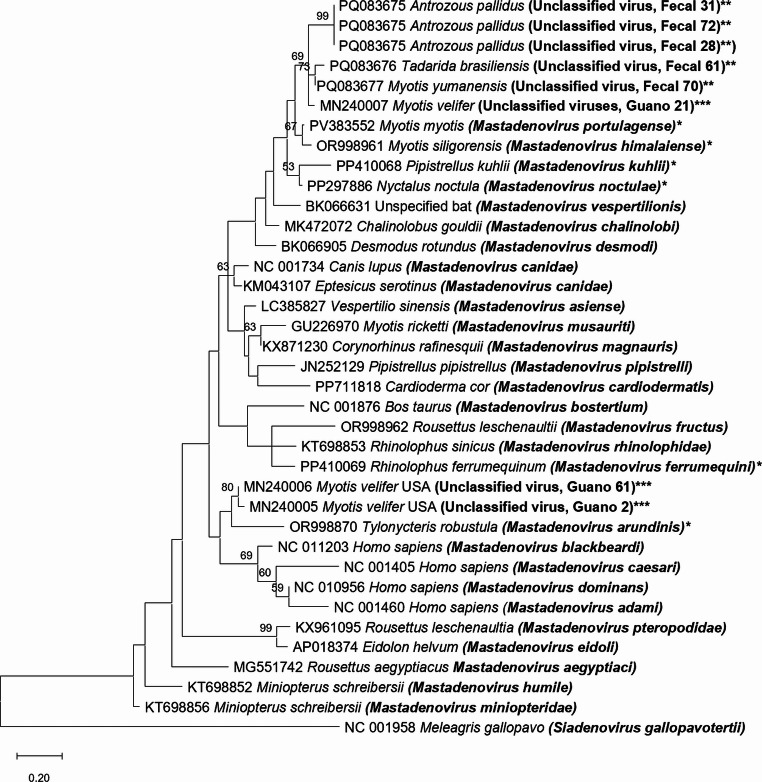 Figure 1
Peer Reviews
No public reviews on file for this paper yet. If you reviewed it on a platform where reviews are public (OpenReview, ICLR, NeurIPS, ICML), you can paste yours below so the community can read it here.
Videos
No videos yet. Explain this paper in a talk, walkthrough, or lecture? Add one.
Taxonomy
TopicsVirus-based gene therapy research · Bat Biology and Ecology Studies · Xenotransplantation and immune response