Repeated exposure to task-relevant and task-irrelevant information – and their interaction – affect visual search performance
Chloe Callahan-Flintoft, Patrick H. Cox, Emma M. Siritzky, Stephen R. Mitroff, Kelvin S. Oie, Dwight J. Kravitz

TL;DR
The study explores how repeated exposure to relevant and irrelevant visual information affects how quickly people can find targets in visual search tasks.
Contribution
The study reveals how exposure to task-irrelevant background information interacts with task-relevant exposure to influence visual search performance.
Findings
Exposure to target-present trials speeds up target detection but slows rejection of target-absent trials.
Exposure to salient distractors reduces response times for target-present trials but not for target-absent trials.
Background exposure decreases response times in both trial types, especially when target exposure is low.
Abstract
The human visual system adapts to statistical regularities in the environment to facilitate visual processing. While laboratory-based tasks make clear distinctions between how task-relevant and task-irrelevant visual information can guide this adaptation, such discretization is rarely available in the real world. As such, it remains unclear exactly what information the visual system tracks to flexibly adapt to a given task. The current study used a massive visual search dataset from the mobile game Airport Scanner. Effects of exposure over a range of more task-relevant (e.g., target presence) to less task-relevant (e.g., background context) features were analyzed in an omnibus model to predict response times in both target-present and target-absent trials. As in previous work (Kramer et al., Journal of Experimental Psychology: General, 151 (8), 1854, 2022), increased exposure to…
Genes, proteins, chemicals, diseases, species, mutations and cell lines named across the full text — each resolved to its canonical identifier and authoritative record.
Click any figure to enlarge with its caption.
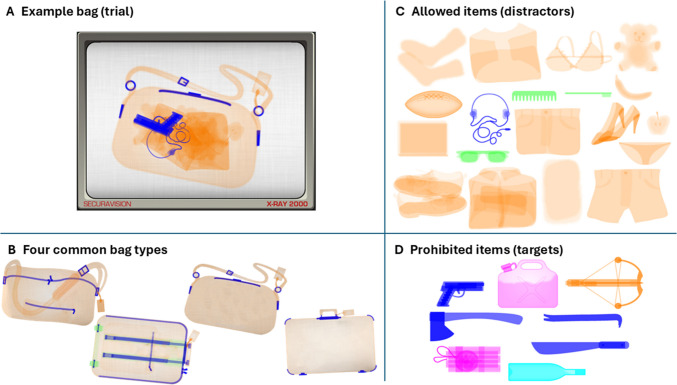 Figure 1
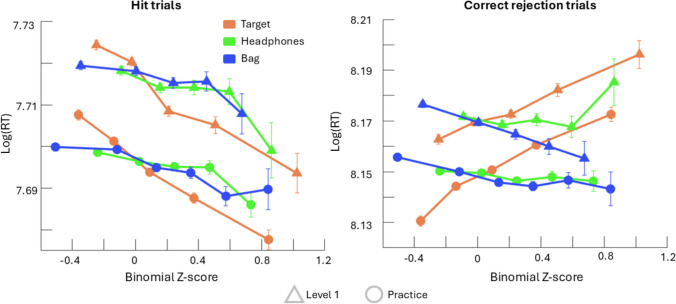 Figure 2
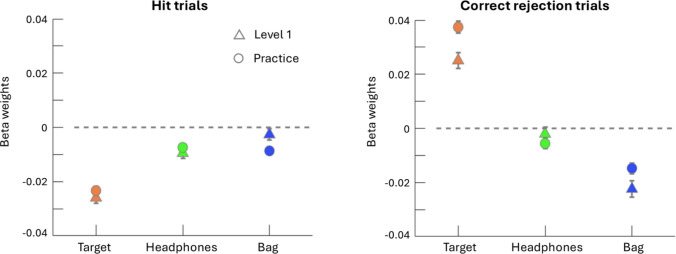 Figure 3
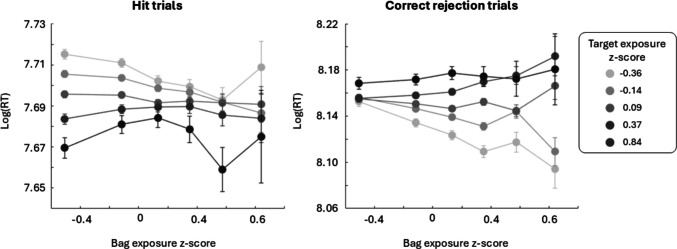 Figure 4
Peer Reviews
No public reviews on file for this paper yet. If you reviewed it on a platform where reviews are public (OpenReview, ICLR, NeurIPS, ICML), you can paste yours below so the community can read it here.
Videos
No videos yet. Explain this paper in a talk, walkthrough, or lecture? Add one.
Taxonomy
TopicsNeural and Behavioral Psychology Studies · Human-Automation Interaction and Safety · Visual Attention and Saliency Detection