Fock state probability changes in open quantum systems
Clare Burrage, Christian Käding

TL;DR
This paper introduces a new method to study how probabilities of quantum states change in systems interacting with their environment, avoiding complex differential equations.
Contribution
A path integral-based method is used to compute reduced density matrices in open quantum systems, bypassing traditional master equations.
Findings
The method allows direct computation of Fock state probability changes in scalar quantum field theory.
Initial correlations in vacuum or two-particle states significantly affect their time evolution.
Lighter neutrino masses cause stronger particle number distortions due to environmental interactions.
Abstract
Open quantum systems are powerful effective descriptions of quantum systems interacting with their environments. Studying changes of Fock state probabilities can be intricate in this context since the prevailing description of open quantum dynamics is by master equations of the systems’ reduced density matrices, which usually requires finding solutions for a set of complicated coupled differential equations. In this article, we show that such problems can be circumvented by employing a recently developed path integral-based method for directly computing reduced density matrices in scalar quantum field theory. For this purpose, we consider a real scalar field \documentclass[12pt]{minimal} \usepackage{amsmath} \usepackage{wasysym} \usepackage{amsfonts} \usepackage{amssymb} \usepackage{amsbsy} \usepackage{mathrsfs} \usepackage{upgreek}…
Click any figure to enlarge with its caption.
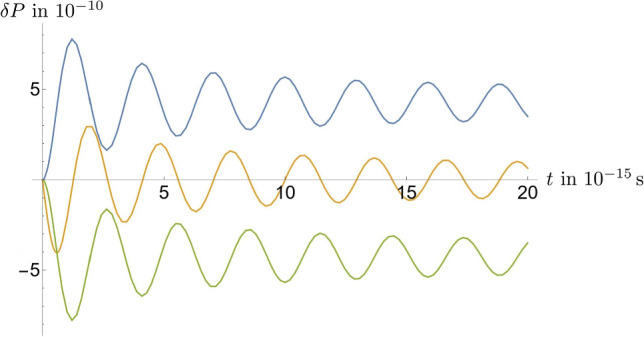 Figure 1
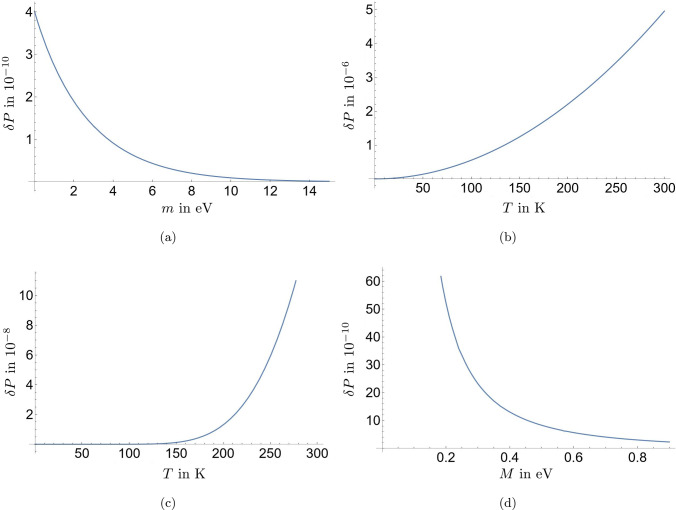 Figure 2
Peer Reviews
No public reviews on file for this paper yet. If you reviewed it on a platform where reviews are public (OpenReview, ICLR, NeurIPS, ICML), you can paste yours below so the community can read it here.
Videos
No videos yet. Explain this paper in a talk, walkthrough, or lecture? Add one.
Taxonomy
TopicsQuantum optics and atomic interactions · Quantum Information and Cryptography · Cold Atom Physics and Bose-Einstein Condensates