Knowledge, attitudes, and practices toward avian influenza among free-grazing duck farmers in Central Thailand: An analytical cross-sectional study
Supanat Boonyapisitsopa, Kamonpan Charoenkul, Napawan Bunpapong, Supassama Chaiyawong, Chanakarn Nasamran, Kannika Thammasutti, Chutarat Saengkul, Somsak Pakpinyo, Kanokwan Suwannarong, Alongkorn Amonsin

TL;DR
This study examines how much free-grazing duck farmers in Thailand know about avian influenza and their practices to prevent it, finding that while knowledge is good, preventive actions need improvement.
Contribution
The study provides the first comprehensive assessment of knowledge, attitudes, and practices regarding avian influenza among free-grazing duck farmers in Thailand.
Findings
Most participants had good knowledge and positive attitudes about avian influenza, but only 38.6% reported good preventive practices.
Knowledge was linked to working hours, animal contact, and vaccination history, while practices were influenced by education and biosecurity measures.
Correlations were found between knowledge and attitudes, and between attitudes and practices, suggesting interconnected behavioral patterns.
Abstract
Free-grazing duck (FGD) production systems play a vital economic role in Thailand but are also recognized as potential sources and amplifiers of avian influenza (AI) viruses at the human–animal–environment interface. Understanding the knowledge, attitudes, and practices (KAP) of individuals involved in FGD production is crucial for effective prevention and control of AI. This study aimed to assess AI-related KAP levels among FGD farmers and related workers in central Thailand and to identify demographic, occupational, and behavioral factors linked to these KAP outcomes. An analytical cross-sectional survey was conducted from January to May 2023, involving 101 participants working in FGD production systems across Ayutthaya, Suphan Buri, and Nakhon Sawan provinces. Data were obtained through face-to-face interviews using a structured, expert-validated questionnaire that covered…
Genes, proteins, chemicals, diseases, species, mutations and cell lines named across the full text — each resolved to its canonical identifier and authoritative record.
Click any figure to enlarge with its caption.
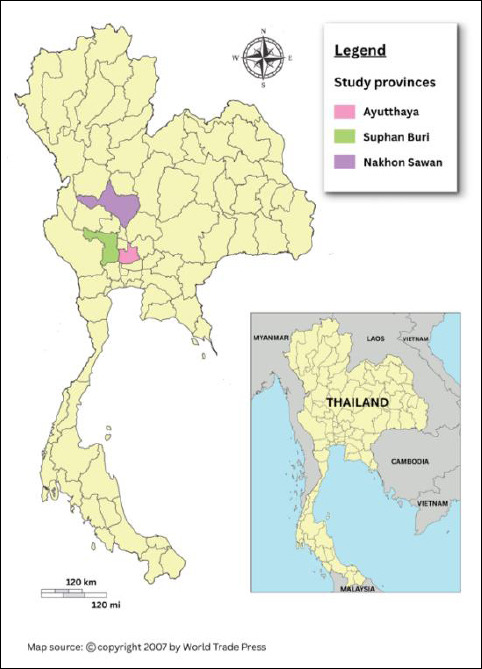 Figure 1
Peer Reviews
No public reviews on file for this paper yet. If you reviewed it on a platform where reviews are public (OpenReview, ICLR, NeurIPS, ICML), you can paste yours below so the community can read it here.
Videos
No videos yet. Explain this paper in a talk, walkthrough, or lecture? Add one.
Taxonomy
TopicsLivestock and Poultry Management · Influenza Virus Research Studies · Animal Disease Management and Epidemiology