Serum Uric Acid Levels in Older Adults: Associations With Clinical Outcomes and Implications for Reference Intervals in Those Aged 70 Years and Over
Amanda J. Rickard, Cammie Tran, Hans G. Schneider, Flavia M. Cicuttini, Anita E. Wluka, Ego Seeman, Johannes T. Neumann, Md Nazmul Karim, Zhen Zhou, Sultana Monira Hussain, David P. Q. Clark, Daniel Clayton‐Chubb, Andrew M. Tonkin, Lawrence J. Beilin, Robyn L. Woods

TL;DR
This study establishes reference intervals for serum uric acid in older adults and finds no major health risks within these ranges, except for a higher fracture risk in women with low levels.
Contribution
The study provides new reference intervals for serum uric acid in adults aged 70+ and identifies a novel association between low SUA and fracture risk in women.
Findings
Reference intervals for SUA were 0.24 to 0.54 mmol/L for men and 0.19 to 0.48 mmol/L for women.
Low SUA levels in women were associated with an increased risk of fractures.
No significant associations were found between SUA levels and major health outcomes like mortality or dementia.
Abstract
Reports have linked both high and low serum uric acid (SUA) levels to adverse health outcomes. This study aimed to establish a reference interval for SUA in older adults and assessed its association with clinically relevant outcomes in relatively healthy, community‐dwelling individuals aged ≥70 years old. The study used data from the ASPirin in Reducing Events in the Elderly (ASPREE) trial. In Australia, 11,878 ASPREE participants had baseline SUA measurements (median age 74 years old). The study sample (n = 11,446; 55% women) comprised individuals with baseline SUA measurements, excluding those on urate‐lowering medication. The reference sample (n = 10,501; 55% women) was established after further exclusion of participants with impaired renal function, defined as an estimated glomerular filtration rate <45 mL/min/1.73m2. Reference intervals (2.5th and 97.5th percentile) were…
Genes, proteins, chemicals, diseases, species, mutations and cell lines named across the full text — each resolved to its canonical identifier and authoritative record.
Click any figure to enlarge with its caption.
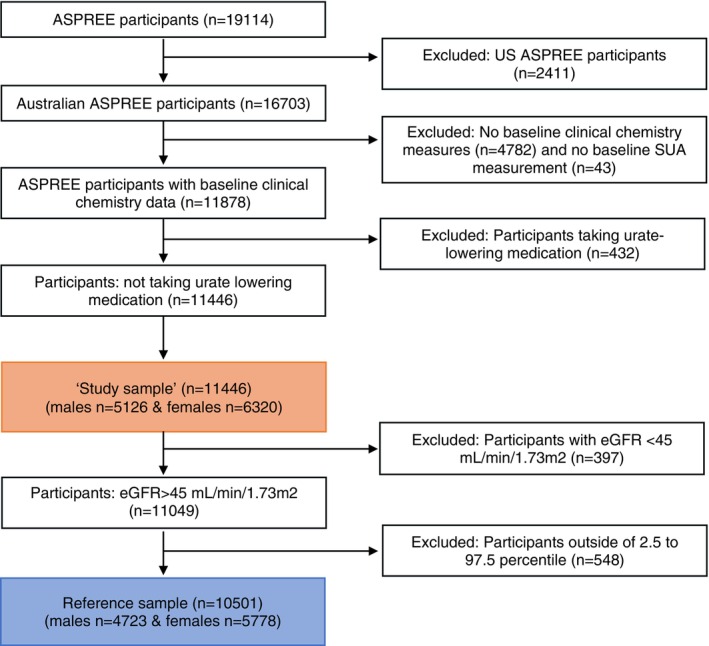 Figure 1
Peer Reviews
No public reviews on file for this paper yet. If you reviewed it on a platform where reviews are public (OpenReview, ICLR, NeurIPS, ICML), you can paste yours below so the community can read it here.
Videos
No videos yet. Explain this paper in a talk, walkthrough, or lecture? Add one.
Taxonomy
TopicsGout, Hyperuricemia, Uric Acid · Bone and Joint Diseases · Inflammasome and immune disorders