Long-term biochemical stability of fresh-frozen plasma from Asian elephants (Elephas maximus) stored at −20°C: Implications for emergency transfusion protocols for elephant endotheliotropic herpesvirus hemorrhagic disease
Chatchote Thitaram, Pakkanut Bansiddhi, Araya Pakamma, Kontawan Arintasai, Siripat Khammesri, Chonticha Sirikul, Worapong Kosaruk, Janine L. Brown, Preeyanat Vongchan

TL;DR
This study shows that frozen plasma from Asian elephants remains stable for up to 12 months, supporting its use in treating deadly herpesvirus disease in young elephants.
Contribution
First systematic evaluation of fresh-frozen plasma stability in Asian elephants for emergency transfusion protocols.
Findings
Fibrinogen concentrations remained stable in stored plasma for up to 12 months.
Factor VIII activity decreased by 16% after 12 months but remained clinically acceptable.
IgG and albumin concentrations increased during storage, likely due to cryoconcentration.
Abstract
Elephant endotheliotropic herpesvirus hemorrhagic disease (EEHV-HD) is a leading cause of fatal hemorrhagic illness in juvenile Asian elephants (Elephas maximus), often requiring urgent plasma transfusion. However, the biochemical stability of fresh-frozen plasma (FFP) during long-term storage has not been systematically evaluated in this species. This study assessed the stability of key plasma proteins, fibrinogen, clotting factor VIII, immunoglobulin G (IgG), and albumin, in FFP stored at −20°C for 4, 8, and 12 months, and compared them with fresh plasma to determine suitability for emergency clinical use. Plasma samples were collected from 20 healthy elephants and processed into fresh and frozen aliquots. Fibrinogen concentrations were quantified using the Clauss assay, factor VIII activity via a one-stage clotting assay, and IgG and albumin concentrations using colorimetric…
Genes, proteins, chemicals, diseases, species, mutations and cell lines named across the full text — each resolved to its canonical identifier and authoritative record.
Click any figure to enlarge with its caption.
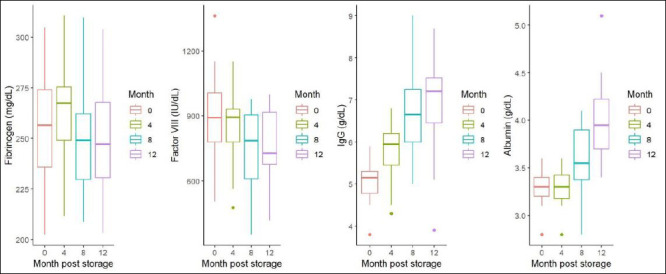 Figure 1
Peer Reviews
No public reviews on file for this paper yet. If you reviewed it on a platform where reviews are public (OpenReview, ICLR, NeurIPS, ICML), you can paste yours below so the community can read it here.
Videos
No videos yet. Explain this paper in a talk, walkthrough, or lecture? Add one.
Taxonomy
TopicsBlood transfusion and management · Animal health and immunology · Hemophilia Treatment and Research