Anthropometry After Prematurity and Foetal Growth Restriction in Childhood and Adolescence
Achim Fieß, Alica Hartmann, Stephanie D. Grabitz, Eva Mildenberger, Omar Hahad, Julia Winter, Alexander K. Schuster, Sandra Gißler, Dirk Wackernagel

TL;DR
The study shows that being born preterm or with abnormal fetal growth affects children's height, weight, and head size, emphasizing the need for early monitoring and interventions.
Contribution
The study provides new insights into how varying degrees of prematurity and fetal growth deviations affect anthropometric outcomes in children and adolescents.
Findings
Lower gestational age is associated with reduced height, weight, and head circumference across childhood and adolescence.
SGA birth is consistently linked to shorter height, lower weight, and smaller head circumference, especially in school age and adolescence.
LGA birth is associated with increased height at school age and higher weight in early childhood and adolescence.
Abstract
Limited evidence exists on how different degrees of prematurity and foetal growth deviations impact anthropometric outcomes during childhood and adolescence. The Gutenberg Prematurity Study Young (GPSY) is a retrospective cohort with prospective assessments of 4–17‐year‐olds born preterm or at term at the University Medical Center Mainz, Germany. Participants were classified by gestational age and birth weight into five categories: severely small for gestational age (SGA; < 3rd percentile), moderately SGA (3rd–< 10th percentile), appropriate for gestational age (AGA; 10th–90th percentile), moderately large for gestational age (LGA; > 90th–97th percentile) and severely LGA (> 97th percentile). Anthropometric parameters were analysed using multivariable regression models. Among 949 participants (median age 12.0 years; 52% female), lower gestational age was associated with reduced height…
Genes, proteins, chemicals, diseases, species, mutations and cell lines named across the full text — each resolved to its canonical identifier and authoritative record.
Click any figure to enlarge with its caption.
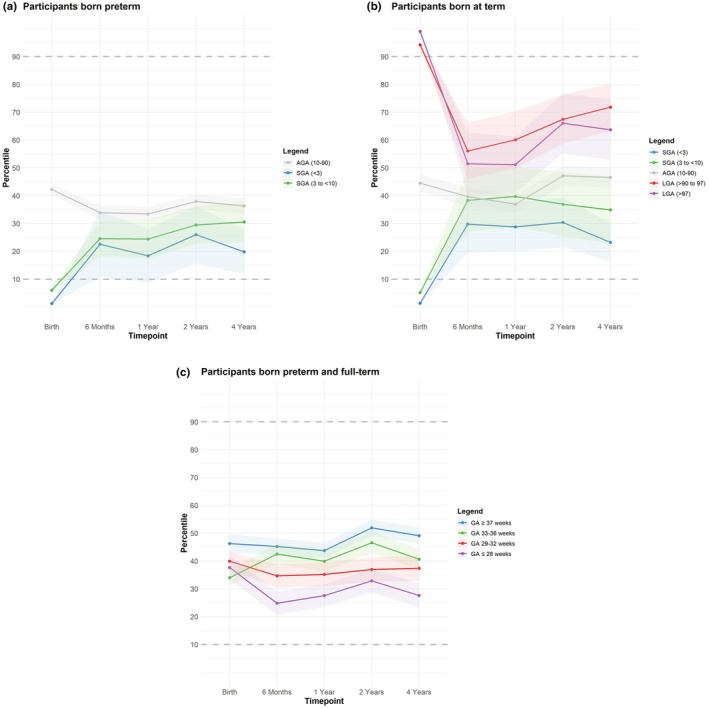 Figure 1
Peer Reviews
No public reviews on file for this paper yet. If you reviewed it on a platform where reviews are public (OpenReview, ICLR, NeurIPS, ICML), you can paste yours below so the community can read it here.
Videos
No videos yet. Explain this paper in a talk, walkthrough, or lecture? Add one.
Taxonomy
TopicsInfant Development and Preterm Care · Birth, Development, and Health · Infant Nutrition and Health