Field evaluation of visual endoscope-assisted transcervical artificial insemination in goats: Effects on insemination time and pregnancy outcomes under tropical conditions
Sarawut Sringam, Pongthorn Suwannathada, Panisara Kunkitti, Peerapat Deesuk, Awirut Wichaiwong, Patchanee Sringam

TL;DR
A new method for goat insemination using a visual endoscope was tested in tropical conditions and showed faster procedure times and similar pregnancy rates compared to traditional methods.
Contribution
The study introduces and evaluates a minimally invasive visual endoscope-assisted insemination method for goats in field settings.
Findings
VE-TCAI reduced insemination time, with 78% of does inseminated within 1 minute compared to 39% with C-TCAI.
Pregnancy rates were numerically higher with VE-TCAI (45.5%) than C-TCAI (33.3%), though not statistically significant.
No major complications were observed, and the overall conception rate was 37.8% across both methods.
Abstract
Artificial insemination (AI) in goats is constrained by the complex cervical anatomy, which limits the efficiency of conventional transcervical AI (C-TCAI), particularly under field conditions. Although laparoscopic AI (LAI) achieves higher fertility rates, its invasive nature, need for anesthesia, and high operational costs limit its routine application. Visual endoscope-assisted transcervical AI (VE-TCAI) offers a minimally invasive alternative that enables real-time cervical visualization and potentially improves procedural efficiency. This study evaluated the field performance of VE-TCAI compared with C-TCAI in native–Boer crossbred goats by assessing insemination time and pregnancy outcomes. A total of 37 multiparous native–Boer crossbred does maintained on two commercial farms in northeastern Thailand were enrolled in a completely randomized field trial. Estrus was synchronized…
Genes, proteins, chemicals, diseases, species, mutations and cell lines named across the full text — each resolved to its canonical identifier and authoritative record.
Click any figure to enlarge with its caption.
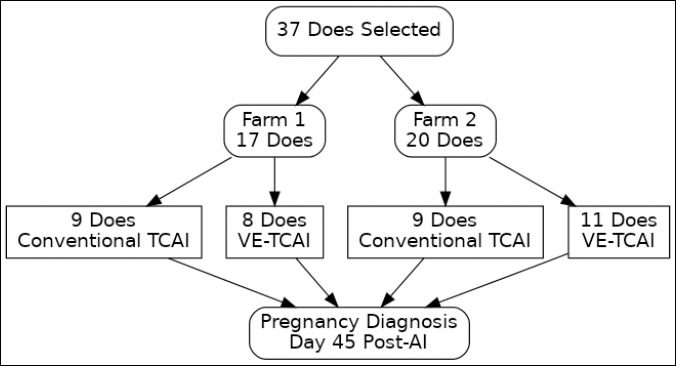 Figure 1
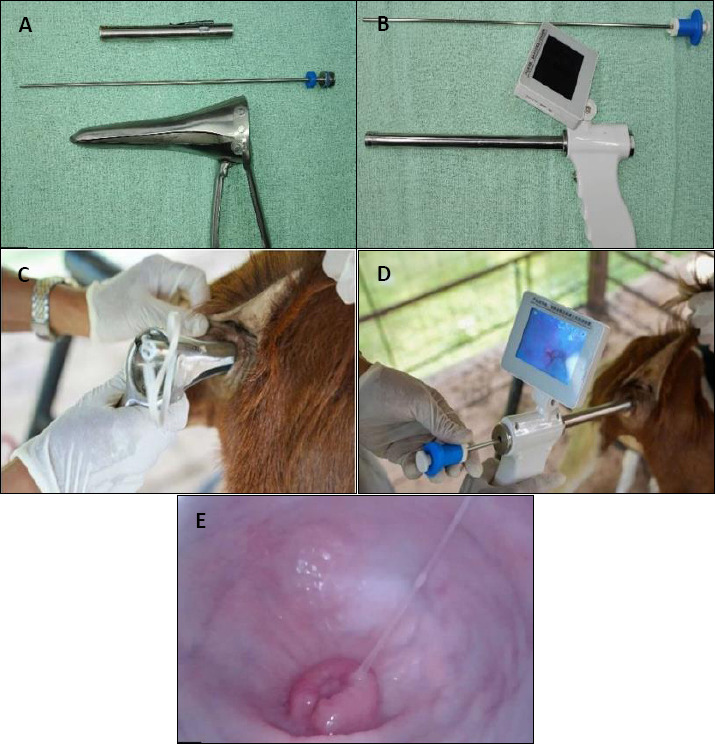 Figure 2
Peer Reviews
No public reviews on file for this paper yet. If you reviewed it on a platform where reviews are public (OpenReview, ICLR, NeurIPS, ICML), you can paste yours below so the community can read it here.
Videos
No videos yet. Explain this paper in a talk, walkthrough, or lecture? Add one.
Taxonomy
TopicsReproductive Physiology in Livestock · Ovarian function and disorders · Reproductive Biology and Fertility