Professional dog trainers’ perspectives on training methods: ethical and evidentiary insights
Jamie L. DeLeeuw, Todd J. Williams

TL;DR
This study explores how professional dog trainers with different training styles view ethics and effectiveness in their work, highlighting differences in their approaches and calls for better regulation and collaboration.
Contribution
The paper introduces insights into ethical and evidentiary reasoning among reward-based and mixed-methods dog trainers, advocating for adversarial collaboration to improve the field.
Findings
Trainers across orientations prioritize positive reinforcement and canine emotional well-being.
Reward-based trainers emphasize behavioral science and deontological ethics, while mixed-methods trainers use consequentialist reasoning.
Mixed-methods trainers rated positive punishment and reinforcement as equally effective despite using reinforcement more often.
Abstract
The professional dog training field sits at the intersection of applied behavioral science, ethics, and lived experience. Despite its significant animal welfare implications, it remains largely unregulated. This primarily qualitative study, complemented by quantitative analyses, examined how professional trainers with differing methodological orientations conceptualize humane and effective practice. Using stratified sampling, 35 trainers affiliated with independent certification directories (17 reward-based; 18 mixed methods) completed a pre-screen survey and semi-structured interviews. Data were analyzed to explore associations among training approach, certification, and demographics, as well as differences in ethical reasoning, evidentiary interpretation, and views on industry regulation. Across orientations, trainers consistently identified positive reinforcement as their most…
Genes, proteins, chemicals, diseases, species, mutations and cell lines named across the full text — each resolved to its canonical identifier and authoritative record.
Click any figure to enlarge with its caption.
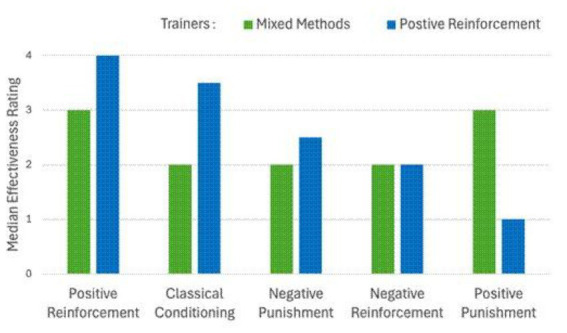 Figure 1
Peer Reviews
No public reviews on file for this paper yet. If you reviewed it on a platform where reviews are public (OpenReview, ICLR, NeurIPS, ICML), you can paste yours below so the community can read it here.
Videos
No videos yet. Explain this paper in a talk, walkthrough, or lecture? Add one.
Taxonomy
TopicsHuman-Animal Interaction Studies · Veterinary Orthopedics and Neurology · Animal Behavior and Welfare Studies