Roles of the integrated stress response in regulation of inflammatory reactions
Fan Jiang, Guei-Sheung Liu, Junjun Liu, Xiaopei Cui, Yanqiu Xing

TL;DR
This paper reviews how the integrated stress response may help reduce inflammation and could be a target for new therapies.
Contribution
It compiles experimental evidence showing the anti-inflammatory potential of the integrated stress response.
Findings
ISR activation leads to reduced protein synthesis and may suppress inflammation.
In vitro and in vivo studies support the anti-inflammatory role of ISR.
ISR is proposed as a potential target for developing anti-inflammatory drugs.
Abstract
The integrated stress response (ISR) is a conserved cyto-protective mechanism, which has fundamental roles in maintaining cell viability under various conditions when intracellular and/or extracellular homeostasis is disrupted. ISR features phosphorylation of the alpha subunit of eukaryotic translation initiation factor 2 (eIF2α), leading to a global reduction in protein synthesis. Emerging evidence suggests that activation of ISR may have anti-inflammatory effects. In this concise review, we summarize the current experimental evidence in this regard from both in vitro and in vivo studies. It is suggested that ISR may represent a potential drug target for developing novel anti-inflammatory therapies.
Genes, proteins, chemicals, diseases, species, mutations and cell lines named across the full text — each resolved to its canonical identifier and authoritative record.
Click any figure to enlarge with its caption.
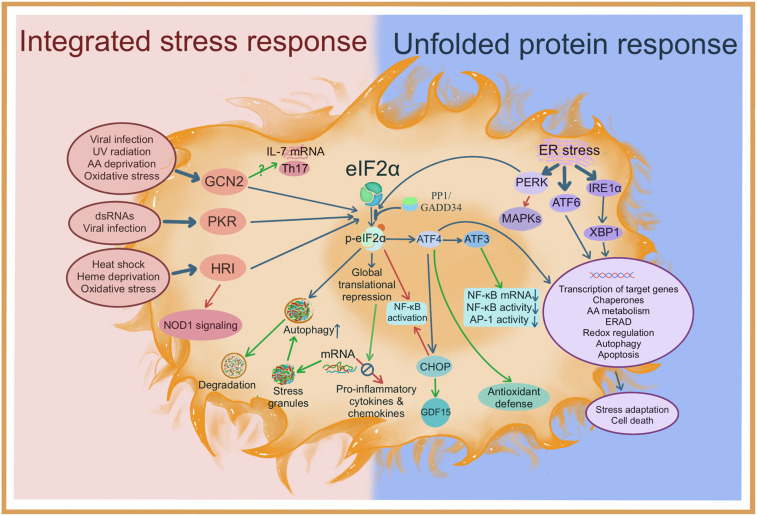 Figure 1
Peer Reviews
No public reviews on file for this paper yet. If you reviewed it on a platform where reviews are public (OpenReview, ICLR, NeurIPS, ICML), you can paste yours below so the community can read it here.
Videos
No videos yet. Explain this paper in a talk, walkthrough, or lecture? Add one.
Taxonomy
TopicsRNA regulation and disease · Endoplasmic Reticulum Stress and Disease · PI3K/AKT/mTOR signaling in cancer