Focusing on microglial mitochondria-lysosome crosstalk and neuroinflammation underlying depression: from molecular pathways to potential therapeutic interventions
Xuelian Zou, Mingqin Shi, Xiangdian Xiao, Xiaoman Lv, Mengjia Yang, Miao Tian, Baiqing Xie, Lijuan Wang, Jing Wang, Dongdong Qin

TL;DR
This paper reviews how microglial mitochondria-lysosome interactions contribute to neuroinflammation in depression and explores potential new treatments.
Contribution
The paper introduces microglial mitochondria-lysosome crosstalk as a novel mechanistic hub in depression-related neuroinflammation.
Findings
Disrupted mitochondrial-lysosome contact sites in microglia lead to increased ROS and pro-inflammatory cytokines.
Abnormalities in microglial mitochondria-lysosome crosstalk reinforce neuroinflammatory circuits in depression.
Restoring microglial mitochondria-lysosome pathways is proposed as a new therapeutic strategy for depression.
Abstract
Depression is a prevalent emotional disorder that significantly impacts global health. Its etiology is multifactorial, and current therapeutic options have notable limitations, underscoring the need to identify novel molecular targets and therapeutic strategies. Neuroinflammation is a key pathophysiological feature of depression, with microglia serving as innate immune cells in the central nervous system (CNS), playing a crucial role in neuroinflammation sensing and amplification. Mitochondria and lysosomes, which are responsible for energy metabolism and waste degradation, respectively, forms non-fusogenic interactions at mitochondrial–lysosomal contact sites (MLCs) in microglia, promoting physical contact and signal transduction, thereby modulating microglial metabolic states and inflammatory phenotypes. Disruption of MLCs can lead to reactive oxygen species (ROS) accumulation,…
Genes, proteins, chemicals, diseases, species, mutations and cell lines named across the full text — each resolved to its canonical identifier and authoritative record.
Click any figure to enlarge with its caption.
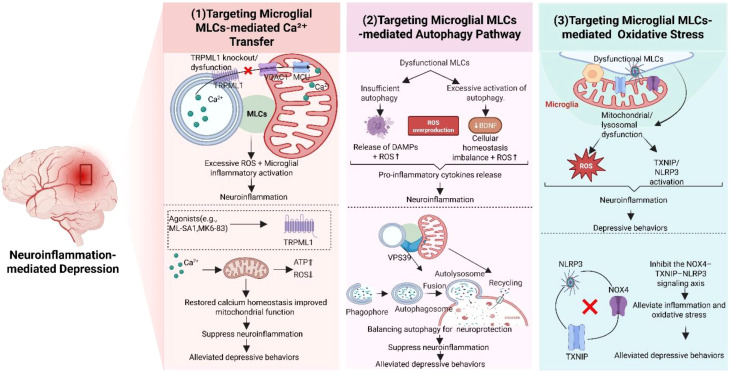 Figure 1
Peer Reviews
No public reviews on file for this paper yet. If you reviewed it on a platform where reviews are public (OpenReview, ICLR, NeurIPS, ICML), you can paste yours below so the community can read it here.
Videos
No videos yet. Explain this paper in a talk, walkthrough, or lecture? Add one.
Taxonomy
TopicsTryptophan and brain disorders · Neuroinflammation and Neurodegeneration Mechanisms · Autophagy in Disease and Therapy