Relationship between anxiety symptoms and cervical motor control in individuals without diagnosed psychiatric or neurological disorders
Andrea Calleja-Caballero, Juan Luis Sánchez-González, Marta Gómez-Mateos, Vanesa Santos-Rodríguez, Jesus Perez, Fátima Pérez-Robledo

TL;DR
The study found that higher anxiety levels are linked to worse cervical motor control in people without psychiatric or neurological disorders.
Contribution
It reveals a novel link between anxiety symptoms and cervical sensorimotor disturbances in non-clinical populations.
Findings
Higher anxiety levels were significantly associated with increased angular error in cervical motor control.
Participants with moderate and severe anxiety showed increased pain perception and motor dysfunction.
Cervical motor control errors and vertigo were independently associated with anxiety severity.
Abstract
This study aimed to explore the association between anxiety symptoms and cervical motor control in individuals without diagnosed psychiatric or neurological disorders. A cross-sectional study was conducted with 101 participants aged 18–60 without diagnosed psychiatric or neurological disorders. Anxiety levels were assessed using the Hamilton Anxiety Rating Scale (HAM-A), a clinician-oriented measure applied here to a non-clinical sample, and severity cut-offs were interpreted cautiously. Cervical motor control was measured using the Head Repositioning Accuracy-to-Target test. Additional clinical variables such as vertigo, cervical pain, and headache were also recorded. Statistical analyses included Spearman correlations, multiple linear and logistic regressions. Higher anxiety levels were significantly associated with increased angular error in cervical motor control, particularly in…
Genes, proteins, chemicals, diseases, species, mutations and cell lines named across the full text — each resolved to its canonical identifier and authoritative record.
Click any figure to enlarge with its caption.
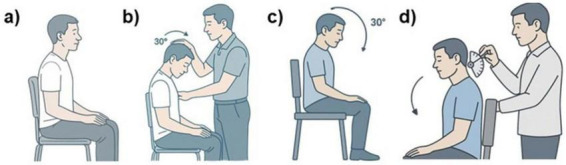 Figure 1
Peer Reviews
No public reviews on file for this paper yet. If you reviewed it on a platform where reviews are public (OpenReview, ICLR, NeurIPS, ICML), you can paste yours below so the community can read it here.
Videos
No videos yet. Explain this paper in a talk, walkthrough, or lecture? Add one.
Taxonomy
TopicsVestibular and auditory disorders · Neural and Behavioral Psychology Studies · Musculoskeletal pain and rehabilitation