Association between weight-adjusted waist index and risk of mortality and disease progression in participants with chronic kidney disease: a prospective study from the UK Biobank
Chengkai Wu, Chuqing Pan, Li Liu, Wenyuan Li

TL;DR
This study shows that a new measure of central obesity, the weight-adjusted waist index, is linked to higher risks of death and kidney disease progression in people with chronic kidney disease.
Contribution
The study introduces the weight-adjusted waist index as a novel obesity metric with better predictive power than BMI or waist circumference in CKD patients.
Findings
WWI showed non-linear associations with all-cause mortality and ESKD, and a linear association with CVD mortality.
WWI values above 10.5 cm/√kg were significantly linked to worse outcomes in CKD patients.
WWI outperformed BMI and waist circumference in predicting all-cause mortality, though its overall discriminative power was modest.
Abstract
The weight-adjusted waist index (WWI), a novel metric reflecting central obesity, has shown potential as a predictor of adverse health outcomes. This study investigated the associations between WWI and all-cause mortality, cardiovascular disease (CVD) mortality, and the incidence of end-stage kidney disease (ESKD) among participants with chronic kidney disease (CKD), and further compared its predictive performance with that of conventional obesity indices. This prospective cohort study was conducted with data from the United Kingdom Biobank (UKB). Participants with CKD at baseline were included, while those with ESKD, missing data on WWI or other obesity indicators, or incomplete covariate information were excluded. Follow-up time was calculated from the baseline to the occurrence of disease diagnoses, surgical interventions, mortality or the censoring date (31 December 2021). CKD was…
Genes, proteins, chemicals, diseases, species, mutations and cell lines named across the full text — each resolved to its canonical identifier and authoritative record.
Click any figure to enlarge with its caption.
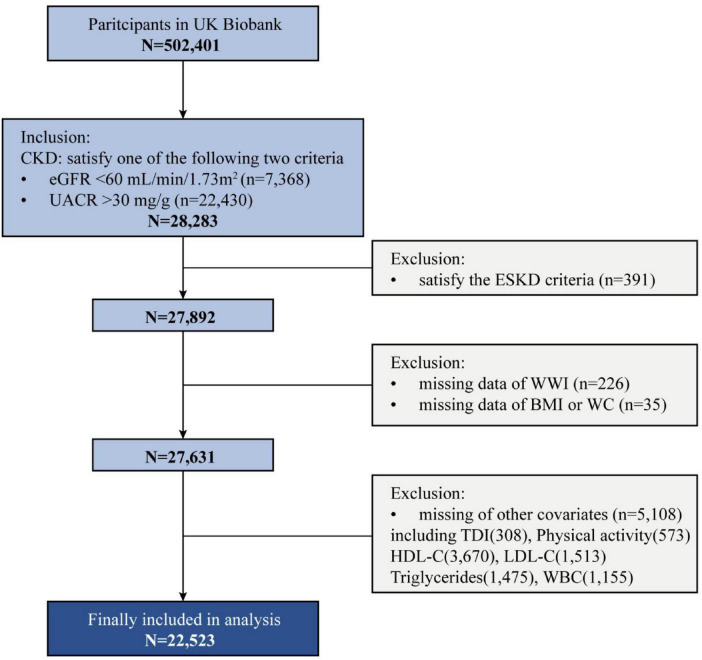 Figure 1
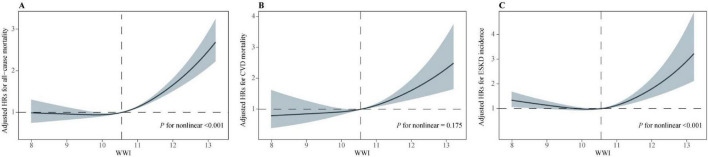 Figure 2
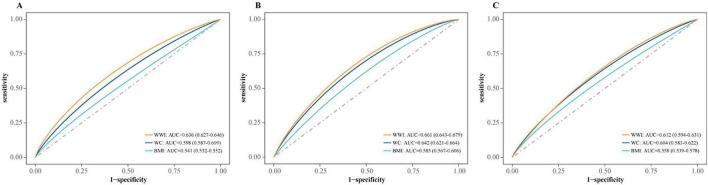 Figure 3
Peer Reviews
No public reviews on file for this paper yet. If you reviewed it on a platform where reviews are public (OpenReview, ICLR, NeurIPS, ICML), you can paste yours below so the community can read it here.
Videos
No videos yet. Explain this paper in a talk, walkthrough, or lecture? Add one.
Taxonomy
TopicsChronic Kidney Disease and Diabetes · Diabetes, Cardiovascular Risks, and Lipoproteins · Cardiovascular Function and Risk Factors