Interactions between genetic predisposition to obesity, insulin resistance and type 2 diabetes risk, and food or beverage intake for incident type 2 diabetes: European Prospective Investigation into Cancer and Nutrition (EPIC) InterAct case–cohort study
Sherly X Li, Fumiaki Imamura, Stephen J Sharp, Matthias B Schulze, Ju-Sheng Zheng, Pilar Amiano, Eva Ardanaz, Manuela M Bergmann, Maria-Dolores Chirlaque, Guy Fagherazzi, Paul W Franks, Sara Grioni, Daniel B Ibsen, Paula Jakszyn, Ingegerd Johansson, Verena A Katzke

TL;DR
This study found no evidence that genetic predisposition to obesity or diabetes changes how diet affects type 2 diabetes risk in Europeans.
Contribution
The study is the first to systematically evaluate gene-diet interactions for type 2 diabetes using polygenic risk scores in a large European cohort.
Findings
No statistical interactions were found between genetic risk scores and dietary factors for type 2 diabetes.
Current polygenic risk score methods may lack the power to detect gene-diet interactions.
Dietary guidelines for diabetes prevention may not need to be tailored based on genetic predisposition.
Abstract
Limited evidence exists for effect modification of genetic characteristics on the associations of food consumption and incident type 2 diabetes (T2D). We aimed to investigate whether the food-T2D association would vary by genetic susceptibility to metabolic traits. We analyzed data from 9542 incident T2D cases and a subcohort of 12,477 participants nested within the 340,234-participant cohort recruited in 1991–1998 and followed up for 10.9 y on average in 8 European countries. Polygenic risk scores (PRSs) for higher body mass index, insulin resistance, and T2D were constructed. Fifteen dietary variables potentially associated with T2D, obtained with cohort-specific self-reported dietary assessment, were examined: fruits, green leafy vegetables, root vegetables, wholegrains, rice, legumes, nuts and seeds, fermented dairy, red meat, processed meat, fish, eggs and egg products,…
Genes, proteins, chemicals, diseases, species, mutations and cell lines named across the full text — each resolved to its canonical identifier and authoritative record.
Click any figure to enlarge with its caption.
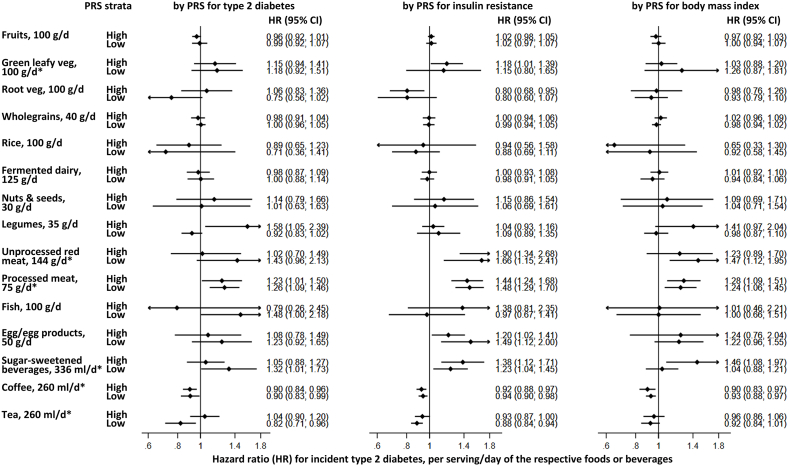 Figure 1
Peer Reviews
No public reviews on file for this paper yet. If you reviewed it on a platform where reviews are public (OpenReview, ICLR, NeurIPS, ICML), you can paste yours below so the community can read it here.
Videos
No videos yet. Explain this paper in a talk, walkthrough, or lecture? Add one.
Taxonomy
TopicsNutrition, Genetics, and Disease · Genetic Associations and Epidemiology · Nutritional Studies and Diet