Breast Cancer Screening Knowledge and Sentiments in Singaporean Women: Mixed Methods Study Using Topic Modeling, Sentiment Analysis, and Structured Questionnaire Data
Peh Joo Ho, Zi Lin Lim, Jenny Liu, Nur Khaliesah Mohamed Riza, Ying Jia Chew, Yi Ying Lim, Hui Ling Tan, Su-Ann Goh, Han Boon Oh, Chi Hui Chin, Sing Cheer Kwek, Zhi Peng Zhang, Desmond Luan Seng Ong, Swee Tian Quek, Sujith Wijerathne, Philip Tsau Choong Iau, Mikael Hartman

TL;DR
This study explores how Singaporean women feel about breast cancer screening using surveys and text analysis, finding that education and emotional framing can influence screening motivation.
Contribution
The study introduces a mixed-methods approach combining NLP with surveys to uncover nuanced emotional and cognitive factors influencing breast cancer screening behavior.
Findings
BC-aware women were significantly more likely to be motivated for screening than BC-unaware women.
Motivated participants emphasized benefits like early detection and health awareness, while neutral participants focused on pain and cost barriers.
Emotional sentiment analysis revealed that identical words like 'health' had different emotional tones depending on participant motivation.
Abstract
Mammography screening uptake in Singapore remains below 40% despite campaigns and subsidies. Natural language processing (NLP) can extract nuanced attitudes from free text that fixed response options miss, revealing latent factors influencing breast cancer (BC) screening behavior. This study characterized women’s attitudes toward mammography using mixed methods data, examined associations between BC awareness and screening willingness, and identified barriers and facilitators through NLP of free-text responses. We conducted a cross-sectional study within the Breast Screening Tailored for Her multicenter cohort in Singapore (October 2021-December 2023). In total, 4169 women aged 35‐59 years (median 48, IQR 43‐54) were recruited via convenience sampling (3 hospitals and 2 polyclinics). Participants completed online structured questionnaires on demographics and screening history, then a…
Genes, proteins, chemicals, diseases, species, mutations and cell lines named across the full text — each resolved to its canonical identifier and authoritative record.
Click any figure to enlarge with its caption.
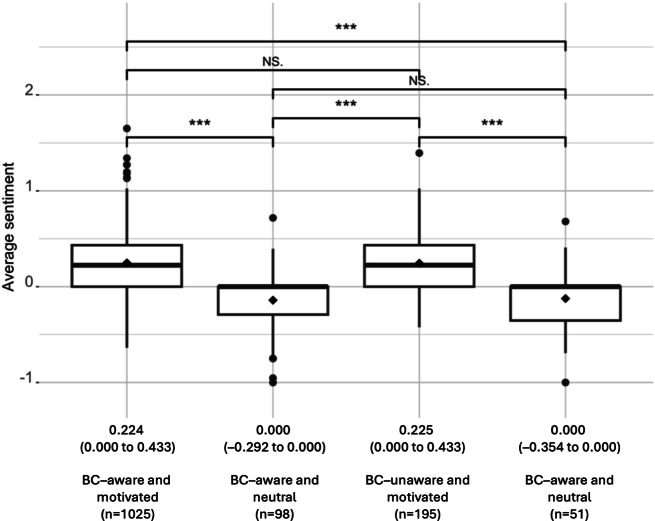 Figure 1
Peer Reviews
No public reviews on file for this paper yet. If you reviewed it on a platform where reviews are public (OpenReview, ICLR, NeurIPS, ICML), you can paste yours below so the community can read it here.
Videos
No videos yet. Explain this paper in a talk, walkthrough, or lecture? Add one.
Taxonomy
TopicsComputational and Text Analysis Methods · Mental Health via Writing · Sentiment Analysis and Opinion Mining