Simulating enzyme catalysis with electrostatically embedded machine learning potentials
Valentin Gradisteanu, Elliot W. Chan, Lester Hedges, Meritxell Malagarriga, Rolf David, Miguel de la Puente, Damien Laage, Iñaki Tuñón, Marc W. van der Kamp, Kirill Zinovjev

TL;DR
This paper introduces a new method to simulate enzyme reactions efficiently by combining machine learning with electrostatic embedding.
Contribution
The novel EMLE method enables accurate enzyme catalysis simulations using gas-phase-trained machine learning potentials.
Findings
EMLE correctly differentiates catalytic actions in enzyme-substrate conformations for Diels–Alderase AbyU.
EMLE accurately captures the catalytic effects of the chorismate to prephenate conversion.
EMLE outperforms mechanical embedding in predicting enzyme catalysis with high accuracy and efficiency.
Abstract
To simulate enzyme reactions, multiscale quantum mechanics/molecular mechanics (QM/MM) approaches are well established and popular. However, accurately and efficiently estimating enzyme activity is a challenge, because in general, precise methods are too computationally expensive. Here, we demonstrate that enzyme catalysis can be captured by coupling efficient, reactive machine-learned potentials (MLPs) trained on gas phase data to the wider enzyme environment using electrostatic machine learning embedding (EMLE). The EMLE scheme is first applied to the natural Diels–Alderase AbyU, showing that it correctly differentiates the catalytic action on different enzyme–substrate conformations. Then, we show that training a reaction-specific EMLE model allows us to accurately capture the enzyme catalytic effects of the conversion of chorismate to prephenate, a reaction with a highly polarizable…
Genes, proteins, chemicals, diseases, species, mutations and cell lines named across the full text — each resolved to its canonical identifier and authoritative record.
Click any figure to enlarge with its caption.
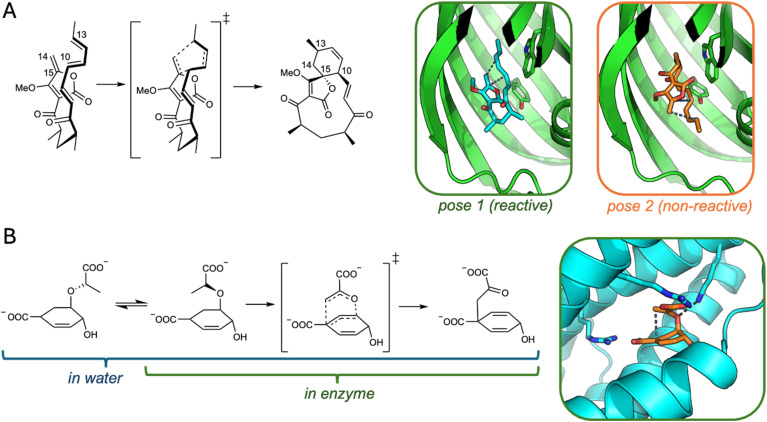 Figure 1
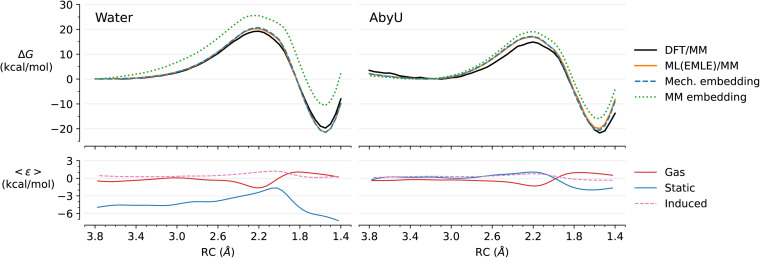 Figure 2
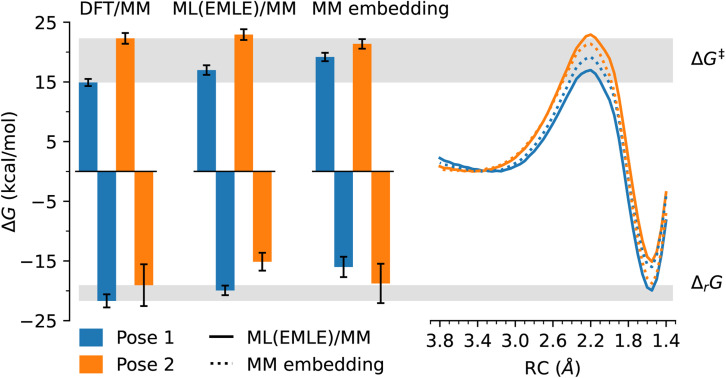 Figure 3
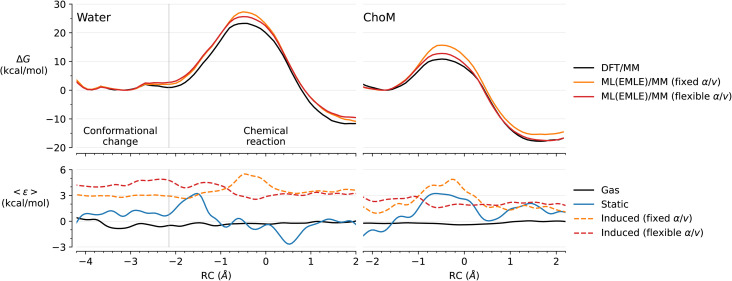 Figure 4
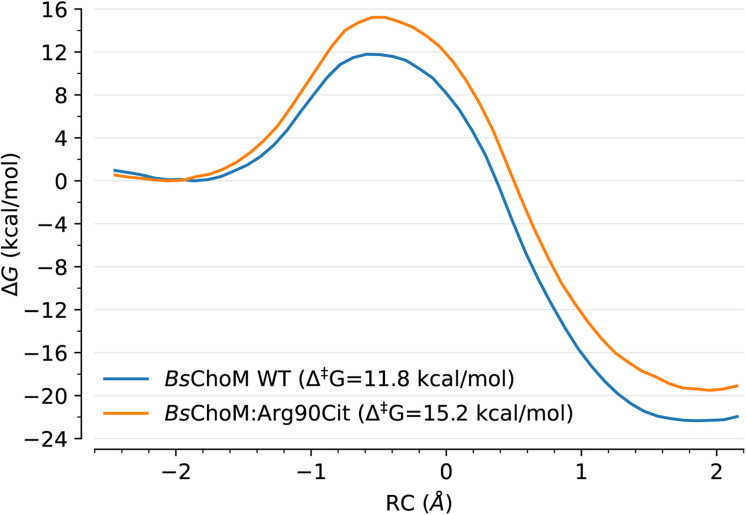 Figure 5
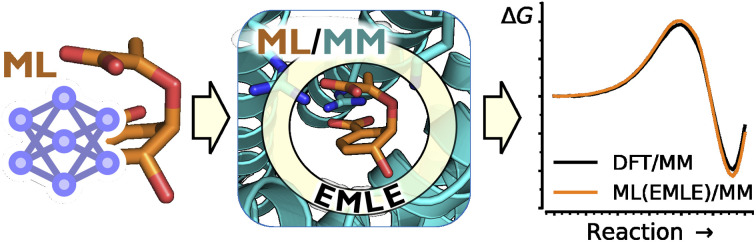 Figure 6
 Figure 7
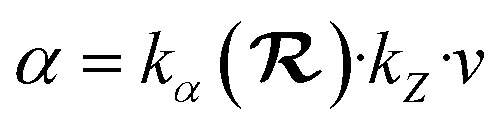 Figure 8
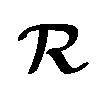 Figure 9
 Figure 10
 Figure 11
Peer Reviews
No public reviews on file for this paper yet. If you reviewed it on a platform where reviews are public (OpenReview, ICLR, NeurIPS, ICML), you can paste yours below so the community can read it here.
Videos
No videos yet. Explain this paper in a talk, walkthrough, or lecture? Add one.
Taxonomy
TopicsMachine Learning in Materials Science · Protein Structure and Dynamics · CO2 Reduction Techniques and Catalysts