Clinical potential and challenges of spatially profiling tumor-infiltrating lymphocytes in early-stage breast cancer
David B. Page, Michael Simanonok, Douglas A. Hanes, Alan Su

TL;DR
This paper explores how mapping immune cell interactions in breast cancer tumors could help predict patient outcomes, but more validation is needed before it can be used in clinics.
Contribution
The paper highlights the potential of spatial profiling as a novel predictive biomarker for early-stage breast cancer.
Findings
Spatial profiling using multispectral immunofluorescence shows promise as a predictive biomarker.
Prospective validation is required for clinical adoption of this technique.
Harmonization with existing biomarkers is necessary for integration into clinical practice.
Abstract
Digitally automated spatial profiling of immune-tumor cell interactions using multispectral immunofluorescence holds promise as a biomarker to predict outcomes in early-stage breast cancer, but prospective validation and harmonization with existing biomarkers is necessary before clinical adoption. In this Perspective, David Page and colleagues discuss how spatially profiling immune-tumor cell interactions using multispectral immunofluorescence analyses holds promise as a biomarker to predict outcomes in early-stage breast cancer.
Genes, proteins, chemicals, diseases, species, mutations and cell lines named across the full text — each resolved to its canonical identifier and authoritative record.
Click any figure to enlarge with its caption.
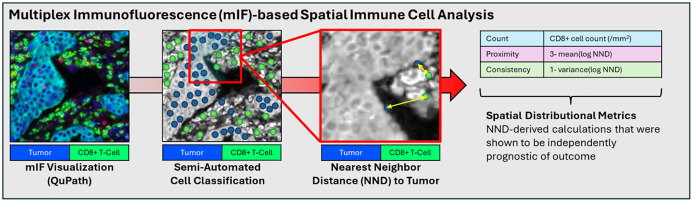 Figure 1
Peer Reviews
No public reviews on file for this paper yet. If you reviewed it on a platform where reviews are public (OpenReview, ICLR, NeurIPS, ICML), you can paste yours below so the community can read it here.
Videos
No videos yet. Explain this paper in a talk, walkthrough, or lecture? Add one.
Taxonomy
TopicsImmune cells in cancer · Cancer Immunotherapy and Biomarkers · Single-cell and spatial transcriptomics