Investment modeling for scalable agricultural learning
Norman Peter Reeves, Rebecca Pietrelli, Ian Brooks, Victor G. Sal y Rosas Celi, Kumpati Narendra, Jean C. Ngabitsinze, Maximo Torero Cullen, Anne N. Lutomia, John W. Medendorp, Julia M. Bello-Bravo, Barry R. Pittendrigh, Yang (Jack) Lu, Yang (Jack) Lu, Yang (Jack) Lu

TL;DR
This paper explores how scalable agricultural learning initiatives can be economically viable by using multilingual animations and YouTube, showing how factors like cost and adoption rates affect returns.
Contribution
The study introduces a systems modeling framework to evaluate the economic impact of scalable agricultural learning initiatives.
Findings
Returns are most influenced by cost per individual, adoption rates, and income gains.
Adapting existing educational content can make learning initiatives economically viable with few farmers.
Tailoring models to specific contexts is crucial for accurate economic impact estimates.
Abstract
With the rise of information and communication technologies, localized farmer training can be transformed into scalable strategies applicable across diverse communities, cultures, and languages. However, the economic value of these approaches and the factors shaping their returns remain underexplored. This study presents a general framework for evaluating the economic impact of scalable agricultural learning initiatives, using multilingual instructional animations and YouTube dissemination as a case study. Systems modeling was used to simulate potential returns, assess key drivers of impact, and estimate the number of farmers required for economic viability. Sensitivity analysis shows that returns are most influenced by the cost to inform an individual, adoption rates, and income gains, and to a lesser degree, technique-sharing rates and adoption costs. When existing educational content…
Genes, proteins, chemicals, diseases, species, mutations and cell lines named across the full text — each resolved to its canonical identifier and authoritative record.
Click any figure to enlarge with its caption.
 Figure 1
 Figure 2
 Figure 3
 Figure 4
 Figure 5
 Figure 6
 Figure 7
 Figure 8
 Figure 9
 Figure 10
 Figure 11
 Figure 12
 Figure 13
 Figure 14
 Figure 15
 Figure 16
 Figure 17
 Figure 18
 Figure 19
 Figure 20
 Figure 21
 Figure 22
 Figure 23
 Figure 24
 Figure 25
 Figure 26
 Figure 27
 Figure 28
 Figure 29
 Figure 30
 Figure 31
 Figure 32
 Figure 33
 Figure 34
 Figure 35
 Figure 36
 Figure 37
 Figure 38
 Figure 39
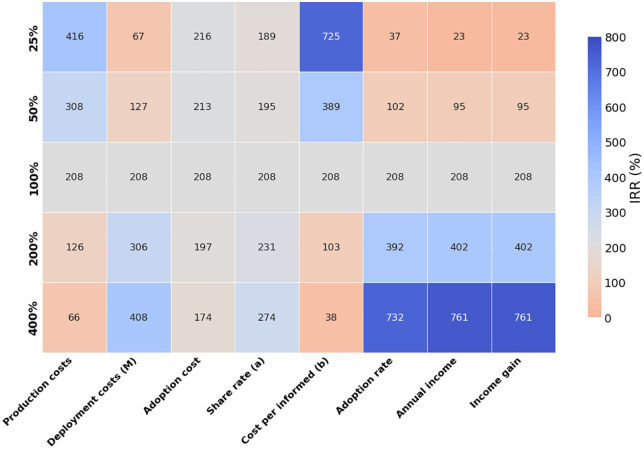 Figure 40
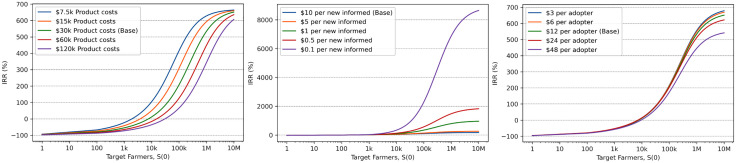 Figure 41
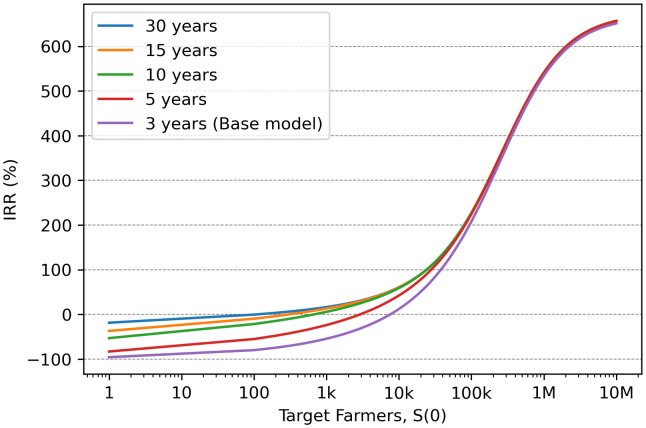 Figure 42
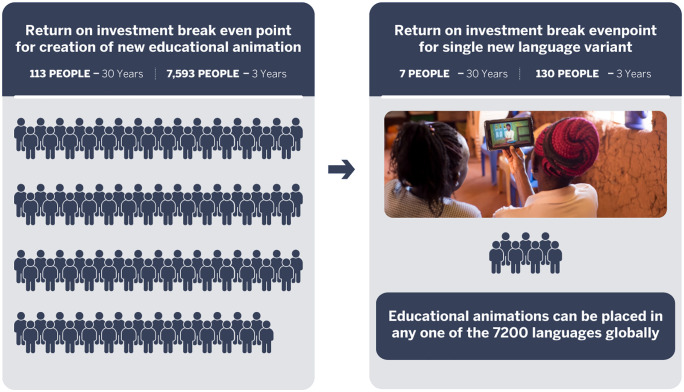 Figure 43
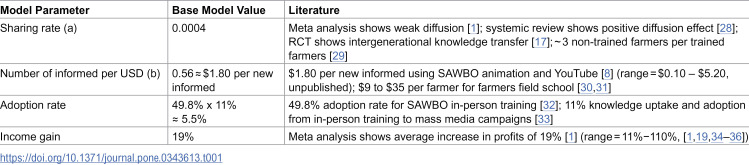 Figure 44
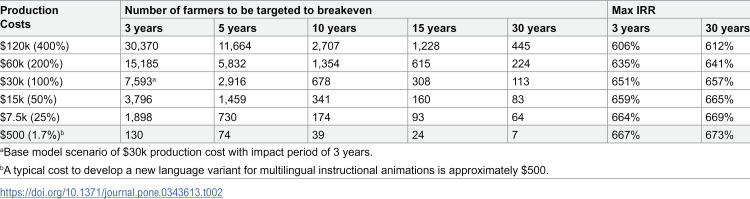 Figure 45
Peer Reviews
No public reviews on file for this paper yet. If you reviewed it on a platform where reviews are public (OpenReview, ICLR, NeurIPS, ICML), you can paste yours below so the community can read it here.
Videos
No videos yet. Explain this paper in a talk, walkthrough, or lecture? Add one.
Taxonomy
TopicsICT in Developing Communities · Diverse Educational Innovations Studies · Agricultural Innovations and Practices