Cis-regulatory evolution of Wnt family genes contributes to a morphological difference between silkworm species
Kenta Tomihara, Ana Pinharanda, Young Mi Kwon, Andrew M. Taverner, Laura S. Kors, Matthew L. Aardema, Julia C. Holder, Lin Poyraz, Takashi Kiuchi, Peter Andolfatto, Ankiit Ahluwalia, Ankiit Ahluwalia, Ankiit Ahluwalia

TL;DR
This study shows how changes in gene regulation, specifically in Wnt genes, drive differences in tail horn size between two related silkworm species.
Contribution
The study identifies cis-regulatory evolution of Wnt genes as a mechanism for morphological divergence without harmful side effects.
Findings
Three major QTLs on chromosome 4 explain a third of the horn size difference between Bombyx mori and Bombyx mandarina.
Cis-regulatory changes in Wnt1 and Wnt6 genes contribute to species-specific horn size differences.
Modular regulatory changes allow key genes to drive morphological evolution without causing widespread negative effects.
Abstract
Closely related species often exhibit distinct morphologies that can contribute to species-specific adaptations and reproductive isolation. One example is Lepidopteran caterpillar appendages, such as the “caudal horn” of Bombycoidea moths, which have evolved substantial morphological diversity among species in this group. Using interspecific crosses, we identify the genetic basis of the caudal horn size difference between Bombyx mori and its closest relative Bombyx mandarina. The three largest of eight QTL account for one third the mean horn length difference between the species. The largest of these, on chromosome 4, encompasses a conserved Wnt family gene cluster, key upstream regulators that are well-known for their roles in morphological diversification in animals. Using allele-specific expression analysis and CRISPR/Cas9 knockouts, we show that tissue-specific cis-regulatory…
Genes, proteins, chemicals, diseases, species, mutations and cell lines named across the full text — each resolved to its canonical identifier and authoritative record.
Click any figure to enlarge with its caption.
 Figure 1
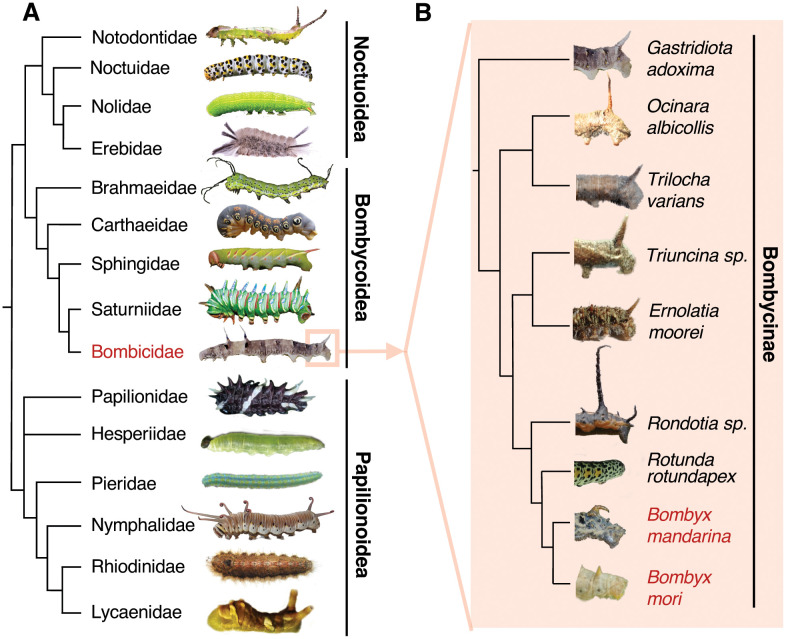 Figure 2
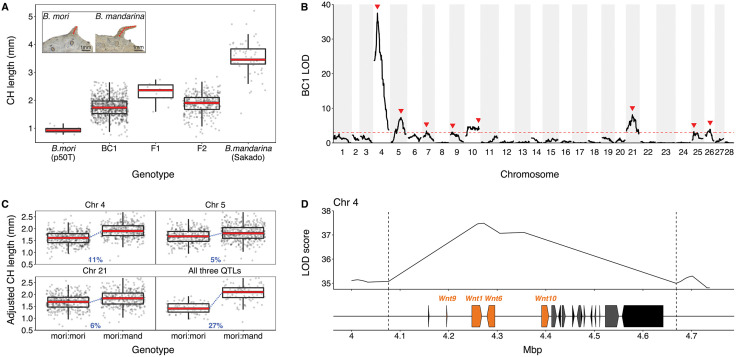 Figure 3
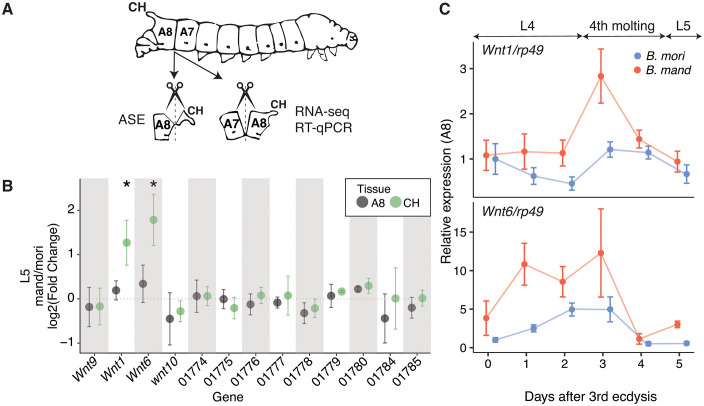 Figure 4
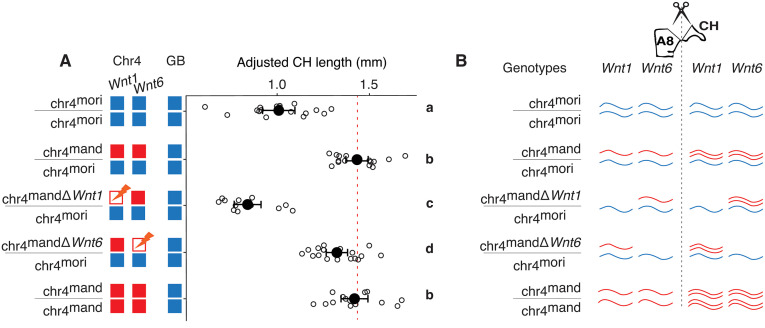 Figure 5
Peer Reviews
No public reviews on file for this paper yet. If you reviewed it on a platform where reviews are public (OpenReview, ICLR, NeurIPS, ICML), you can paste yours below so the community can read it here.
Videos
No videos yet. Explain this paper in a talk, walkthrough, or lecture? Add one.
Taxonomy
TopicsDevelopmental Biology and Gene Regulation · Wnt/β-catenin signaling in development and cancer · Silk-based biomaterials and applications