Visual search for people wearing protective clothing in a forestial environment – Differences between gaze and behavior
Florian S. Oswald, Wolfgang Einhäuser

TL;DR
This study examines how different types of protective clothing affect visibility in forest environments, using reaction times and eye-tracking data to assess safety.
Contribution
The study introduces a novel combination of behavioral and eye-tracking data to evaluate visibility of protective clothing in real-world forest settings.
Findings
Reflective vests reduced errors and were fixated on earlier than other conditions.
Eye-tracking revealed additional saccades to vests before responses, suggesting verification behavior.
Combining eye-tracking with behavioral data provides deeper insights into visibility and safety.
Abstract
To prevent hunting accidents, people in forests should be well-visible to others. However, there is debate which kind of protective clothing should be required. We created a database containing photographs of 22 individuals in forestial settings. The database is available online; for the present study a subset of images was used. The photographed persons (“models”) wore four different clothing variants adding to typical forest garment: Two conditions included protective clothing, either a reflective vest or a hat with reflective hatband. We included two conditions without protective clothing, either with a hat (without hatband) or with no hat, and a condition without person. For the present study, we cropped and scaled the image of the database to generate 800 stimuli (160 per condition). These were presented to N = 16 observers, who were asked to respond as quickly as possible without…
Genes, proteins, chemicals, diseases, species, mutations and cell lines named across the full text — each resolved to its canonical identifier and authoritative record.
Click any figure to enlarge with its caption.
 Figure 1
 Figure 2
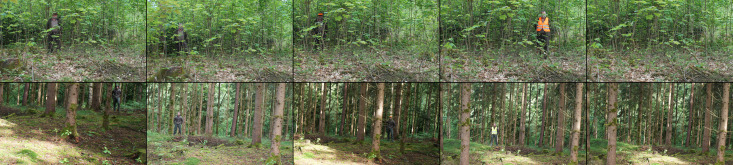 Figure 3
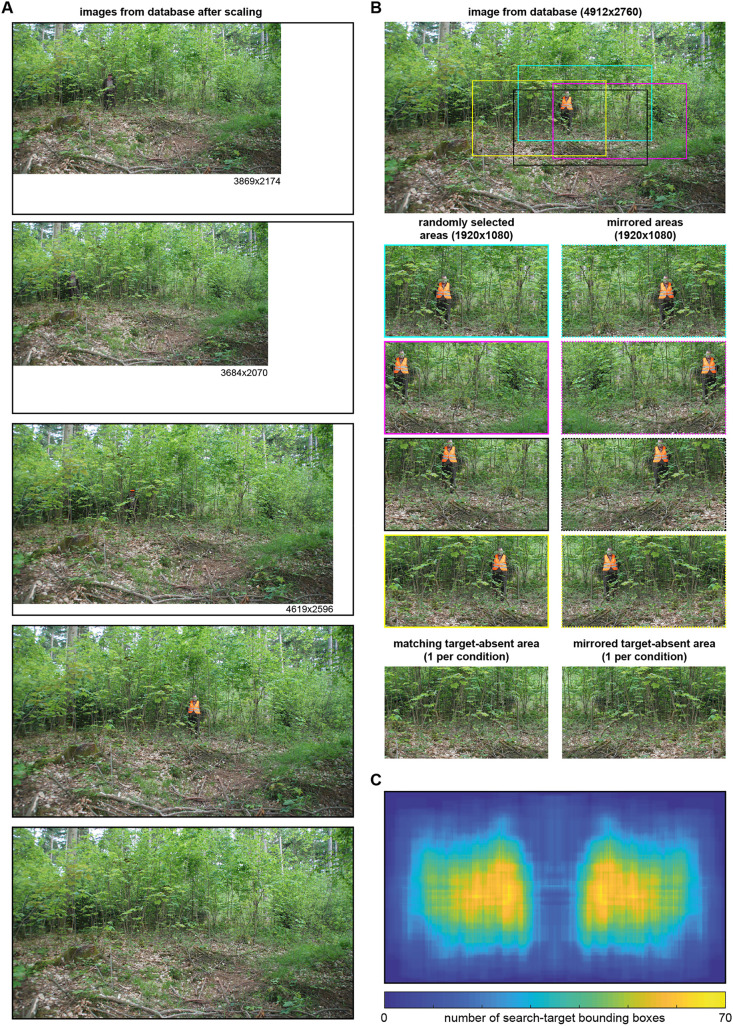 Figure 4
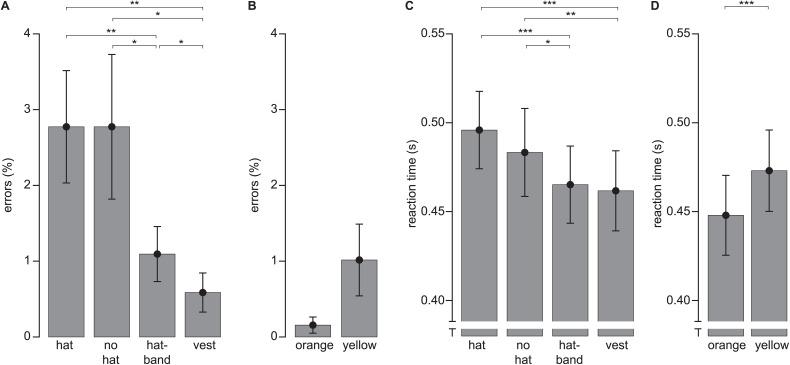 Figure 5
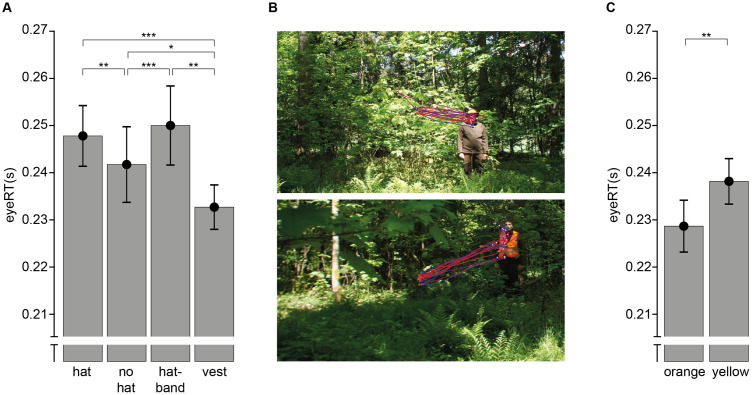 Figure 6
Peer Reviews
No public reviews on file for this paper yet. If you reviewed it on a platform where reviews are public (OpenReview, ICLR, NeurIPS, ICML), you can paste yours below so the community can read it here.
Videos
No videos yet. Explain this paper in a talk, walkthrough, or lecture? Add one.
Taxonomy
TopicsHuman-Animal Interaction Studies · Face Recognition and Perception · Safety Warnings and Signage