“A very first clue on the subject”: A focus group study on users’ perspectives on German plain language summaries of psychological meta-analyses
Claudia Breuer, Marlene Stoll, Gesa Benz, Mark Jonas, Martin Kerwer, Anita Chasiotis, Michal Ptaszynski, Muhammad Aslam, Muhammad Aslam, Muhammad Aslam, Muhammad Aslam, Muhammad Aslam

TL;DR
This study explores how laypeople, practitioners, and science communicators in Germany perceive plain language summaries of psychological meta-analyses and what they find useful.
Contribution
The study provides user-driven insights into the design and utility of plain language summaries for psychological meta-analyses in a German context.
Findings
All user groups valued plain language, clear structure, and short length of summaries.
Laypeople aimed to use summaries for gaining knowledge and making informed decisions.
Science communicators viewed summaries as a starting point for deeper research.
Abstract
Plain Language Summaries (PLSs) are textual summaries of scientific studies that are targeted at lay audiences. PLSs of psychological meta-analyses may benefit laypeople interested in psychological research, psychological practitioners and science communicators. This study explored the perspective of these three user groups on German PLSs of psychological meta-analyses. We wanted to understand the aims and benefits of reading psychological PLSs form their perspective, and how these PLSs should be designed to be useful to them. We conducted four focus group interviews in total. Two focus groups comprised 15 laypeople in sum, one focus group interview comprised six practitioners, and one focus group comprised five science communicators. Interview transcripts were analyzed using content analysis according to Kuckartz and Rädiker. We used main categories for PLS aims and characteristics…
Genes, proteins, chemicals, diseases, species, mutations and cell lines named across the full text — each resolved to its canonical identifier and authoritative record.
Click any figure to enlarge with its caption.
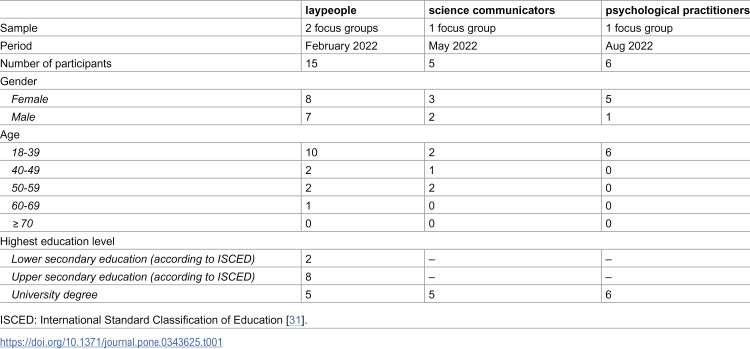 Figure 1
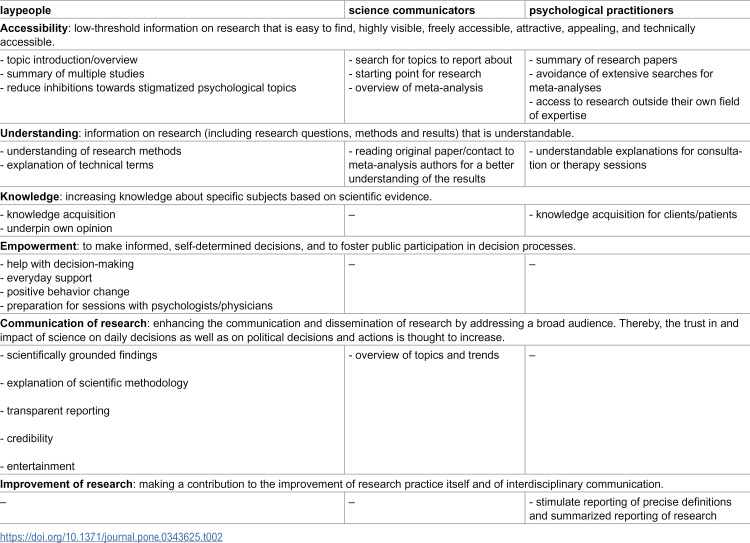 Figure 2
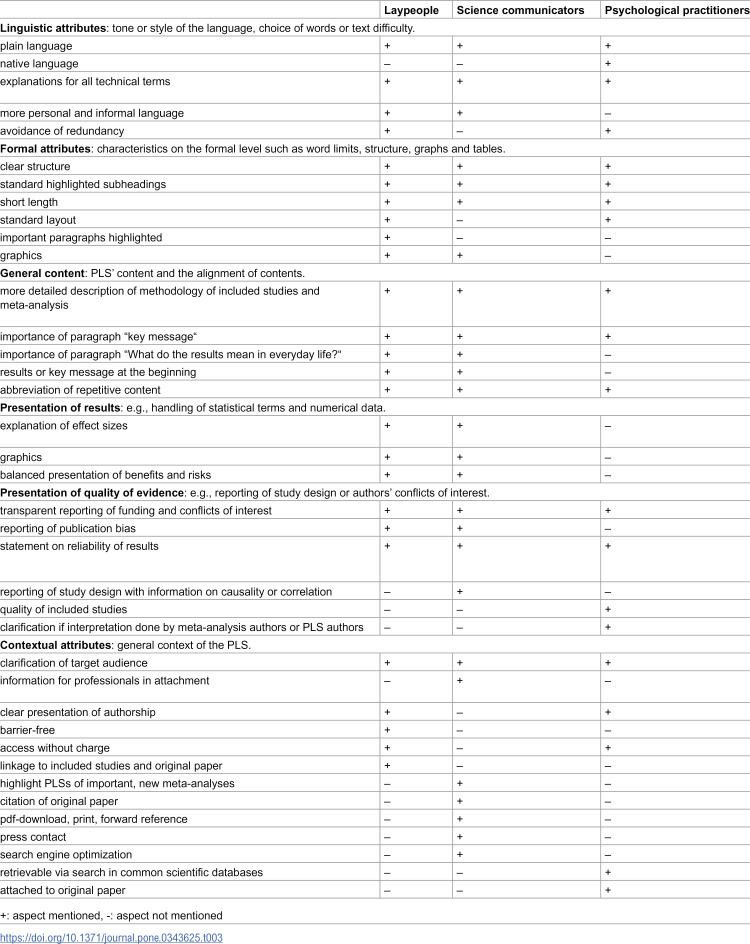 Figure 3
Peer Reviews
No public reviews on file for this paper yet. If you reviewed it on a platform where reviews are public (OpenReview, ICLR, NeurIPS, ICML), you can paste yours below so the community can read it here.
Videos
No videos yet. Explain this paper in a talk, walkthrough, or lecture? Add one.
Taxonomy
TopicsMeta-analysis and systematic reviews · Academic and Historical Perspectives in Psychology · Libraries and Information Services