Agreement of thermodilution and direct Fick methods for cardiac output across varying haemodynamic conditions
Michael Melin, Ida Haugen Löfman, Dmitri Matan, Magnus Nygren, Bahira Shahim, Lars H Lund, Aristomenis Manouras

TL;DR
This study compares two methods for measuring heart output and finds that thermodilution is reliable for assessing pulmonary hypertension despite some inaccuracies in certain conditions.
Contribution
The study reveals a flow-dependent bias in thermodilution measurements but confirms its clinical reliability for estimating pulmonary vascular resistance.
Findings
Thermodilution overestimates cardiac output in low-flow states and underestimates it in normal/high flow.
Thermodilution-derived pulmonary vascular resistance accurately identifies elevated resistance at key thresholds.
Agreement between methods is not affected by tricuspid regurgitation severity.
Abstract
The direct Fick method is the gold standard for measuring cardiac output (Q). However, thermodilution (TD) is more widely used in clinical practice due to its feasibility. As the accuracy of TD-derived Q (QTD) may vary by flow state, it can influence the estimation of pulmonary vascular resistance (PVR) and pulmonary hypertension (PH) classification. This study aimed to compare QTD with Fick-derived Q (QF) across haemodynamic states and evaluate the clinical reliability of TD-derived PVR (PVRTD). We retrospectively analysed 852 right heart catheterizations (2014–22) with simultaneous QTD and QF measurements. 64% of patients had heart failure, and 20% had pulmonary arterial hypertension. QTD correlated strongly with QF (r = 0.78, P < .001) but demonstrated a flow-dependent bias—overestimating Q in low-flow states (+0.1 L/min) and underestimating it in normal/high flow (−0.48 L/min).…
Genes, proteins, chemicals, diseases, species, mutations and cell lines named across the full text — each resolved to its canonical identifier and authoritative record.
Click any figure to enlarge with its caption.
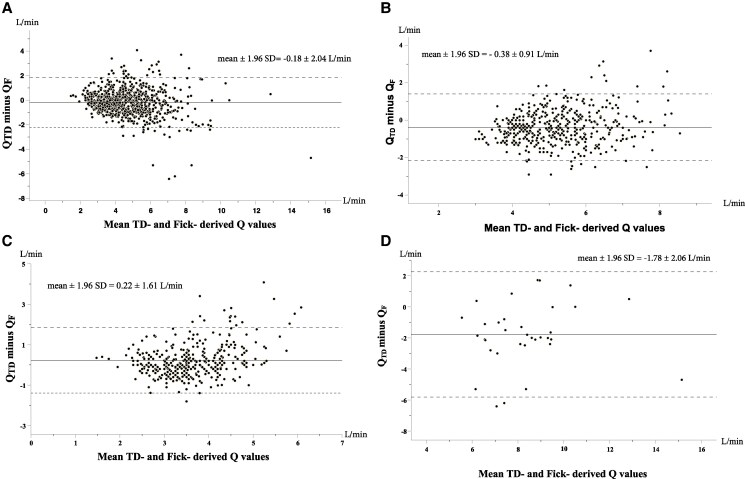 Figure 1
 Figure 2
Peer Reviews
No public reviews on file for this paper yet. If you reviewed it on a platform where reviews are public (OpenReview, ICLR, NeurIPS, ICML), you can paste yours below so the community can read it here.
Videos
No videos yet. Explain this paper in a talk, walkthrough, or lecture? Add one.
Taxonomy
TopicsHemodynamic Monitoring and Therapy · Pulmonary Hypertension Research and Treatments · Sepsis Diagnosis and Treatment