Microbially-induced carbonate precipitation in coal-associated environments: opportunities and challenges
Kuanysh Tastambek, Azhar Malik, Nuraly Akimbekov, Ilya Digel, Nazym Altynbay, Damir Nussipov, Bekzat Kamenov, Dinara Sherelkhan, Moldir Turaliyeva, Yaya Wang, Xiangrong Liu

TL;DR
This paper reviews how bacteria can help reduce coal dust pollution by forming calcium carbonate, but challenges like cost and scalability remain.
Contribution
The paper provides a comprehensive review of MICP mechanisms and strategies for coal dust suppression, emphasizing recent advancements in microbial strain selection and delivery methods.
Findings
Urease-producing bacteria catalyze carbonate formation to bind coal dust particles.
MICP offers low toxicity and ecological compatibility but faces high costs and environmental sensitivity.
Recent advancements focus on optimizing microbial survival and mineralization efficiency in mining conditions.
Abstract
Microbial-induced calcium carbonate precipitation (MICP) has emerged as a promising biotechnological approach for addressing coal dust pollution in mining and industrial environments. Among the various biological agents, urease-producing bacteria play a central role in catalyzing urea hydrolysis, leading to the generation of carbonate ions that react with calcium to form calcium carbonate (CaCO3). This biologically formed mineral binds dust particles, enhances surface stability, and reduces airborne pollutant dispersion. While MICP presents clear environmental and structural advantages, including low toxicity, long-term ecological compatibility, and compatibility with natural ecosystems, the underlying mechanisms, particularly the microbial adhesion to coal particles and subsequent mineralization dynamics, remain poorly understood. High production costs, sensitivity to environmental…
Genes, proteins, chemicals, diseases, species, mutations and cell lines named across the full text — each resolved to its canonical identifier and authoritative record.
Click any figure to enlarge with its caption.
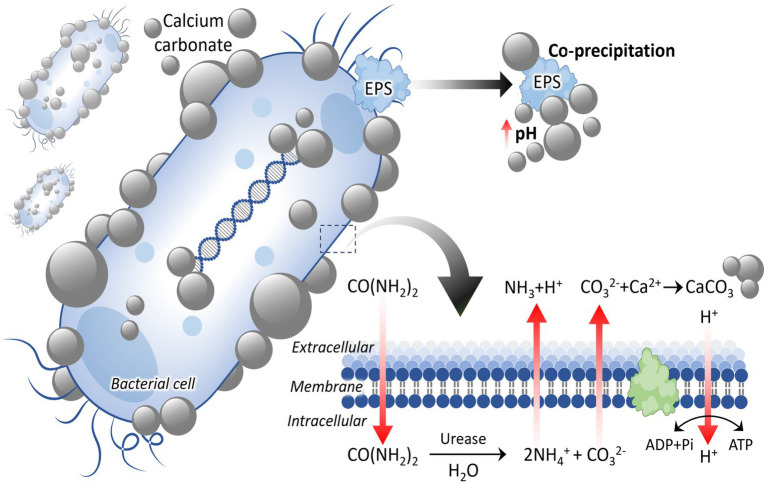 Figure 1
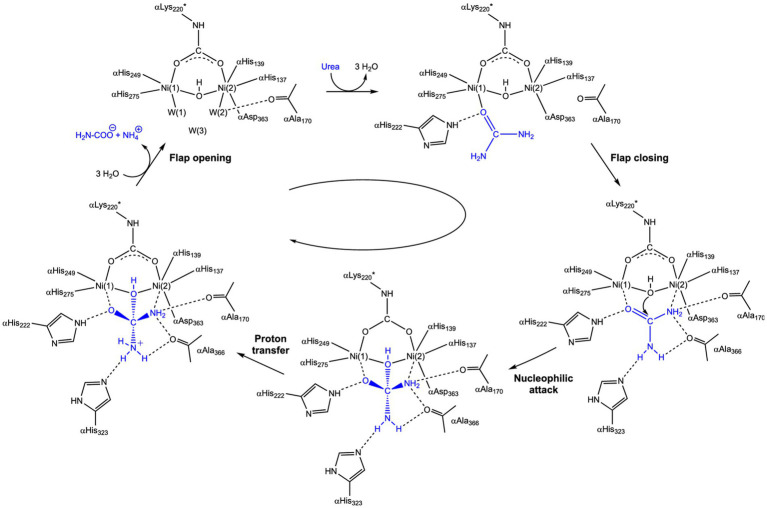 Figure 2
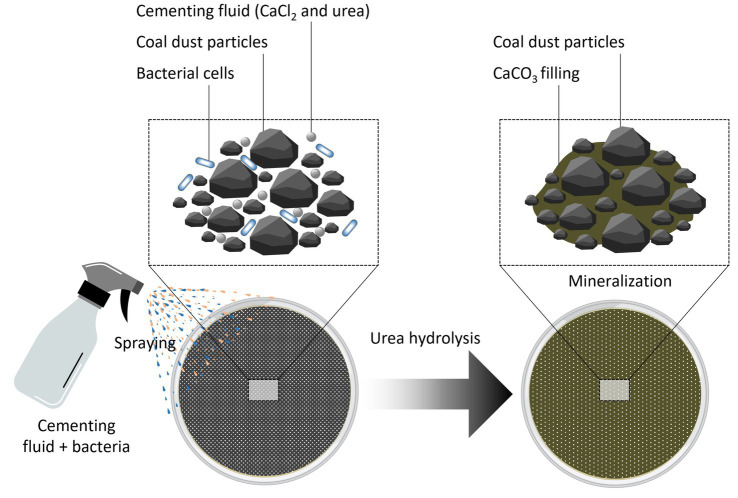 Figure 3
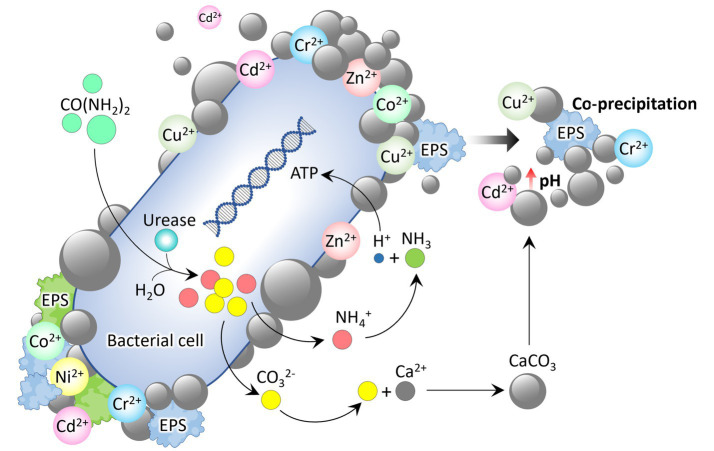 Figure 4
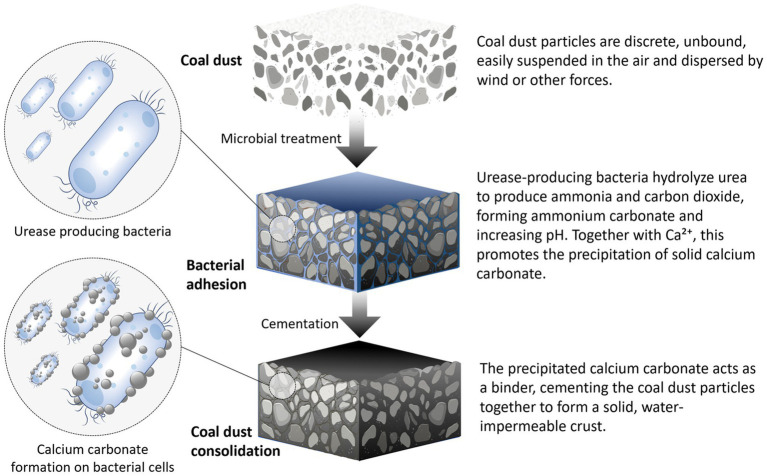 Figure 5
Peer Reviews
No public reviews on file for this paper yet. If you reviewed it on a platform where reviews are public (OpenReview, ICLR, NeurIPS, ICML), you can paste yours below so the community can read it here.
Videos
No videos yet. Explain this paper in a talk, walkthrough, or lecture? Add one.
Taxonomy
TopicsMicrobial Applications in Construction Materials · Building materials and conservation · CO2 Sequestration and Geologic Interactions