Accelerometer-derived “weekend warrior” physical activity pattern and risk of age-related eye diseases: a prospective cohort study
Yuze Mi, Jiahui Zong, Shangdong Wang, Qinnan Zhu, Shaokai Lin, Xinni Zheng, Yanggang Hong, Jiawei Zhou, Liang Ye

TL;DR
This study finds that doing most of your weekly physical activity on weekends, known as the 'weekend warrior' pattern, can still protect against age-related eye diseases, similar to regular daily activity.
Contribution
The study is the first to show that concentrated weekend physical activity reduces eye disease risk as effectively as regular activity.
Findings
Weekend warrior activity reduced cataract risk by 11% compared to inactivity.
The weekend pattern also lowered risks of diabetic retinopathy and macular degeneration.
No significant differences were found between weekend and regular activity for most eye diseases.
Abstract
International guidelines recommend at least 150 min of weekly moderate-to-vigorous physical activity (MVPA), but whether concentrated versus distributed activity patterns differ in their associations with age-related eye diseases remains unclear. This prospective cohort study included 86,271 UK Biobank participants free of age-related eye diseases at baseline. Physical activity was assessed using wrist-mounted triaxial accelerometers (Axivity AX3) over seven consecutive days. Two MVPA thresholds were examined: ≥ 150 min/week (primary) and ≥ 300 min/week (secondary). Participants were categorized as: inactive (below threshold), weekend warriors (WW; meeting threshold with ≥ 50% MVPA concentrated within 1–2 days), or regularly active (meeting threshold without WW criteria). Cox proportional hazards regression models were used to assess associations over a median follow-up of 7.9 years.…
Genes, proteins, chemicals, diseases, species, mutations and cell lines named across the full text — each resolved to its canonical identifier and authoritative record.
Click any figure to enlarge with its caption.
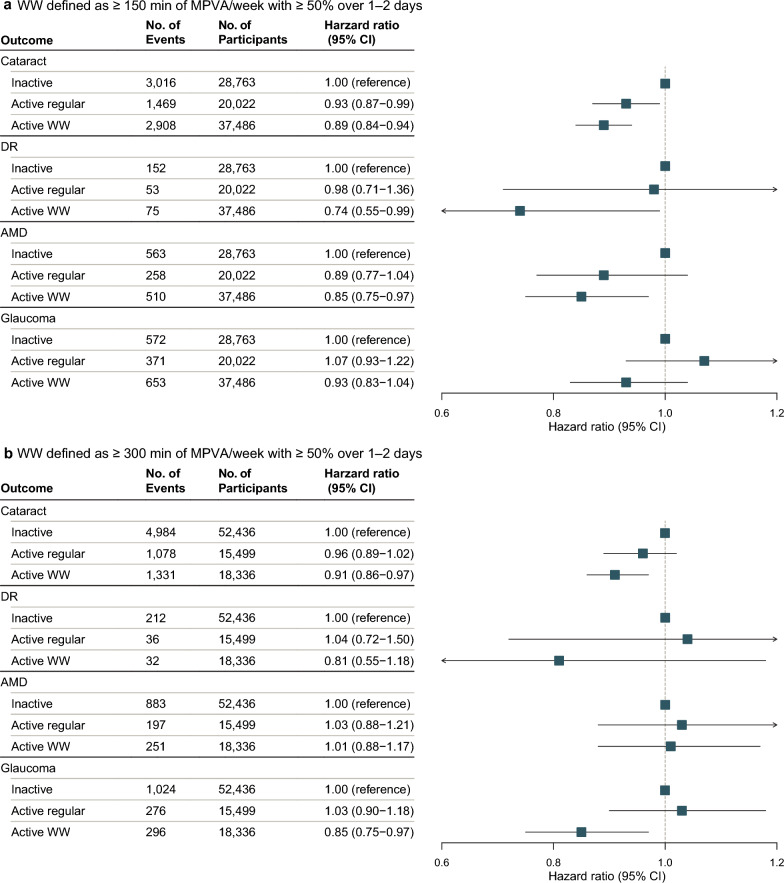 Figure 1
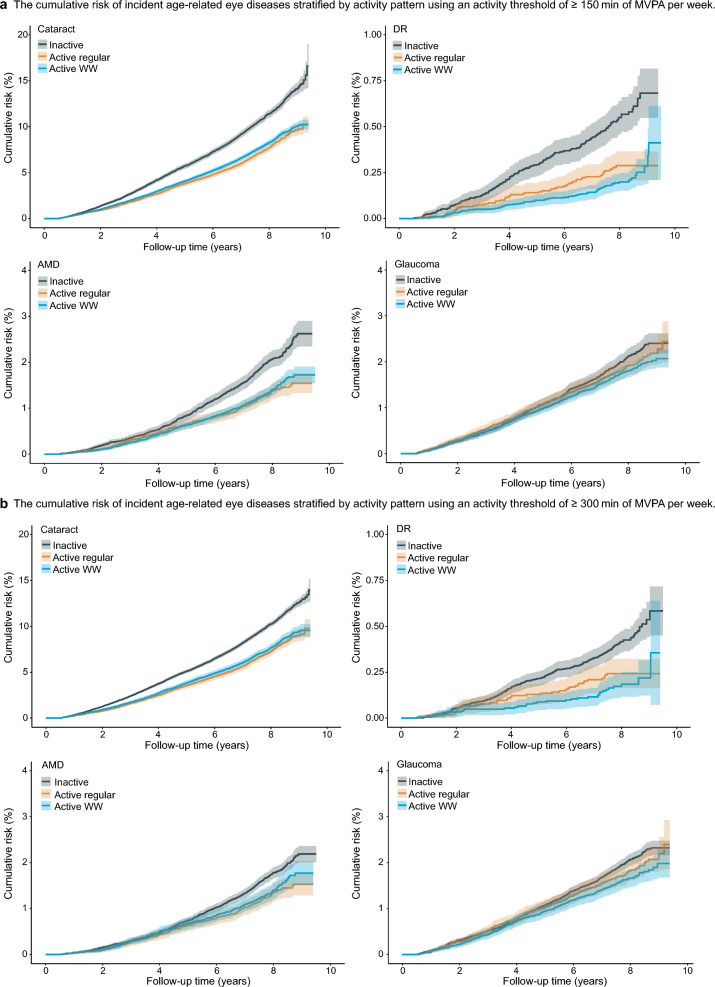 Figure 2
Peer Reviews
No public reviews on file for this paper yet. If you reviewed it on a platform where reviews are public (OpenReview, ICLR, NeurIPS, ICML), you can paste yours below so the community can read it here.
Videos
No videos yet. Explain this paper in a talk, walkthrough, or lecture? Add one.
Taxonomy
TopicsOphthalmology and Visual Impairment Studies · Physical Activity and Health · Ergonomics and Musculoskeletal Disorders