Exploring factors influencing implementation across the explanatory-to-pragmatic trial continuum: a sequential qualitative integration of delivering higher-intensity walking exercise within inpatient stroke rehabilitation
Suzanne Ackerley, Stanley H. Hung, Lisa Sheehy, Sarah J. Donkers, Polina Timofeeva, Krista L. Best, Sue Peters, Sarah S. Park, Béatrice Ouellet, Victor E. Ezeugwu, Marie-Hélène Milot, Brodie M. Sakakibara, Janice J. Eng, Louise A. Connell

TL;DR
This study explores how to implement a walking exercise protocol in stroke rehabilitation by comparing trials under ideal and real-world conditions.
Contribution
The study provides new insights into implementation strategies and practical actions for transitioning from ideal to real-world rehabilitation settings.
Findings
A shift towards greater pragmatism was observed in the WnW trial compared to the DOSE trial.
Managers and champions played a key role in supporting protocol implementation in real-world settings.
Ten ERIC strategies were identified to support implementation, focusing on adaptability and communication.
Abstract
Many innovations with proven efficacy in randomized controlled trials encounter significant barriers to real-world implementation. Using an example from delivery of a higher-intensity walking exercise protocol within inpatient stroke rehabilitation, we explored factors influencing implementation when moving from an explanatory trial under ideal conditions to a more pragmatic trial under real-world conditions. We identified implementation strategies and practical actions for implementation into routine inpatient stroke rehabilitation. Context and perspectives of delivering higher-intensity walking exercise in the Walk ‘n Watch (WnW) pragmatic trial were compared and contrasted with its predecessor, the Determining Optimal post-Stroke Exercise (DOSE) trial. The PRECIS-2 tool was used to quantify trials along the explanatory-to-pragmatic continuum. A sequential qualitative integrative…
Genes, proteins, chemicals, diseases, species, mutations and cell lines named across the full text — each resolved to its canonical identifier and authoritative record.
Click any figure to enlarge with its caption.
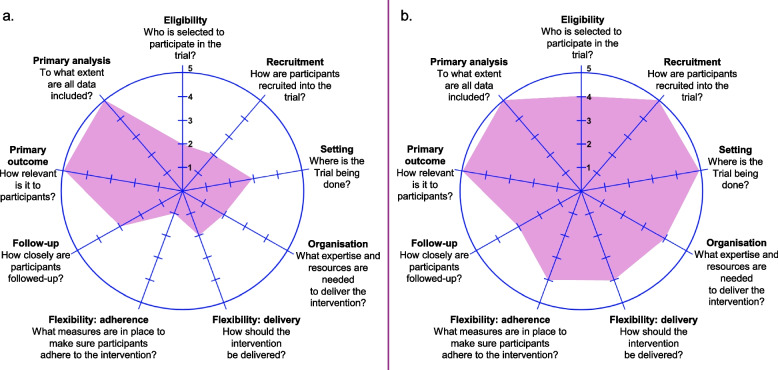 Figure 1
Peer Reviews
No public reviews on file for this paper yet. If you reviewed it on a platform where reviews are public (OpenReview, ICLR, NeurIPS, ICML), you can paste yours below so the community can read it here.
Videos
No videos yet. Explain this paper in a talk, walkthrough, or lecture? Add one.
Taxonomy
TopicsHealth Policy Implementation Science · Occupational Therapy Practice and Research · Mental Health and Patient Involvement