Transferability of a 10-week remotely delivered Virtual Physical Activity Seated Exercise (V-PASE) program on post-stroke functional mobility: study protocol for a multisite randomized controlled trial
Paul Mackie, Maureen C. Ashe, Ruth Barclay, Mark T. Bayley, Sarah J. Donkers, Jamie L. Fleet, W. Ben Mortenson, Sue Peters, Courtney L. Pollock, Sepideh Pooyania, Adria Quigley, Brodie M. Sakakibara, Amy Schneeberg, Lisa Sheehy, Sally Stelling, Jennifer Yao, Janice J. Eng

TL;DR
This study tests if a 10-week seated exercise program delivered remotely can improve mobility in people with chronic stroke and balance issues.
Contribution
The study introduces a remotely delivered seated exercise program for stroke survivors and evaluates its transferability to functional mobility improvements.
Findings
The study will assess if seated exercises can improve lower extremity function and mobility in stroke survivors.
The program's effects on balance, quality of life, and blood profiles will be evaluated alongside mobility outcomes.
Abstract
Seated exercises may reduce the need for in-person support during home-based exercise programs in people with balance impairments. However, it is uncertain if these exercises can transfer to improved lower extremity function and mobility. Thus, the objective is to investigate the effects of a remotely delivered 10-week seated exercise intervention on functional mobility, compared with control, in individuals living with a chronic stroke who have balance impairments. The study is a multi-site, assessor blinded, randomized controlled trial that will recruit across five provinces in Canada using the CanStroke Recovery Trials platform. A total of 100 adults living with a chronic stroke (≥ 6 months post-stroke) and mobility impairment (using a walking aid) will be recruited. Participants will be randomized (1:1) to the 10-week Virtual Physical Activity Seated Exercise (V-PASE) or control…
Genes, proteins, chemicals, diseases, species, mutations and cell lines named across the full text — each resolved to its canonical identifier and authoritative record.
Click any figure to enlarge with its caption.
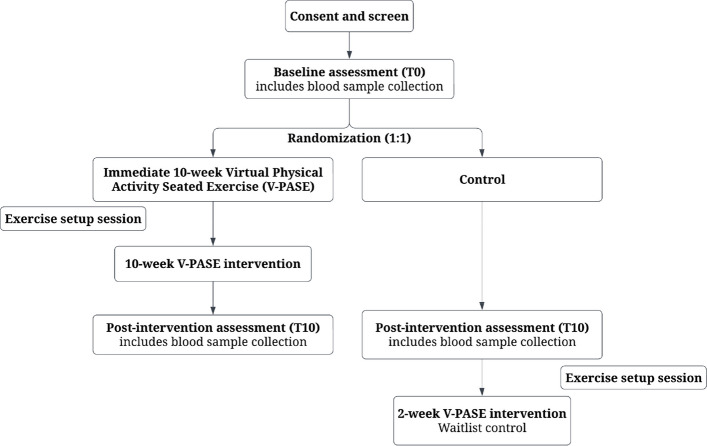 Figure 1
Peer Reviews
No public reviews on file for this paper yet. If you reviewed it on a platform where reviews are public (OpenReview, ICLR, NeurIPS, ICML), you can paste yours below so the community can read it here.
Videos
No videos yet. Explain this paper in a talk, walkthrough, or lecture? Add one.
Taxonomy
TopicsStroke Rehabilitation and Recovery · Balance, Gait, and Falls Prevention · Cerebral Palsy and Movement Disorders