Soil selenium and oesophageal cancer incidence in China: a large ecological study of population-based cancer registry data
Shuanghua Xie, Xianhui Ran, Liacine Bouaoun, Gerrad Jones, Christian Abnet, Anthony Kityo, Wenqiang Wei, Valerie McCormack, Daniel R. S. Middleton

TL;DR
This study finds that low soil selenium levels in China are linked to higher rates of esophageal cancer, especially in areas with selenium deficiency.
Contribution
The study provides new evidence linking soil selenium deficiency to increased esophageal cancer incidence in China using large-scale population data.
Findings
Selenium-deficient areas had more than twofold higher esophageal cancer incidence in males and threefold in females.
EC hotspots in China are located in selenium-deficient regions, though not all selenium-deficient areas have high EC rates.
Above the selenium deficiency threshold, most incidence rates were below 15 per 100,000.
Abstract
Incidence rates of oesophageal cancer (EC), predominantly oesophageal squamous cell carcinoma (ESCC), in areas of China are the highest worldwide. Selenium, a trace element linked to ESCC risk, likely plays a role in ESCC’s enigmatic spatial distribution. We investigated the association between soil selenium and EC incidence in China. We conducted a large ecological study using 2016 population-based EC incidence data from 486 cancer registry catchments covering 380 million people and 74,000 EC cases. We assigned mean soil selenium concentrations to each area from geospatial maps. Age-standardized EC incidence rates (ASRs) were computed. We used linear regression models to estimate approximate incidence rate ratios (IRRs) for ASRs across soil selenium quintiles and for areas classified as deficient (≤ 0.2 mg/kg). The distribution of ASRs differed above and below the selenium deficiency…
Genes, proteins, chemicals, diseases, species, mutations and cell lines named across the full text — each resolved to its canonical identifier and authoritative record.
Click any figure to enlarge with its caption.
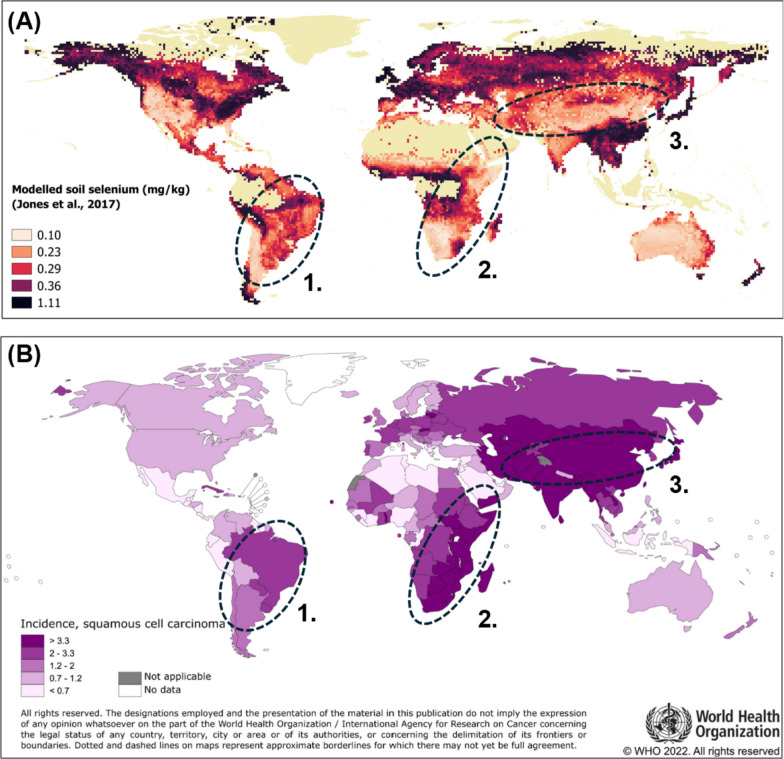 Figure 1
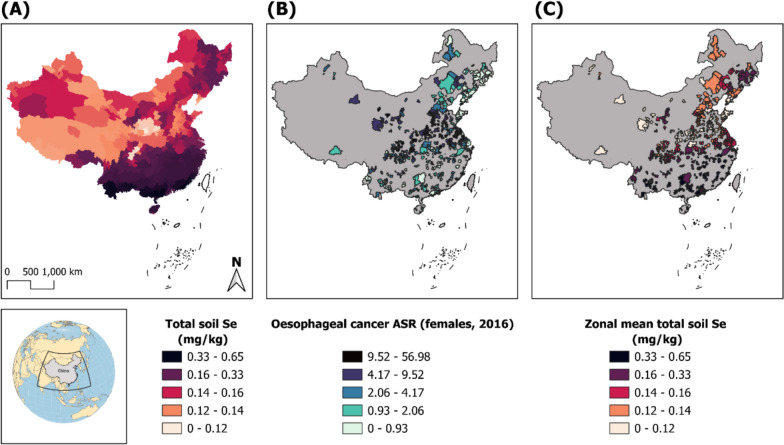 Figure 2
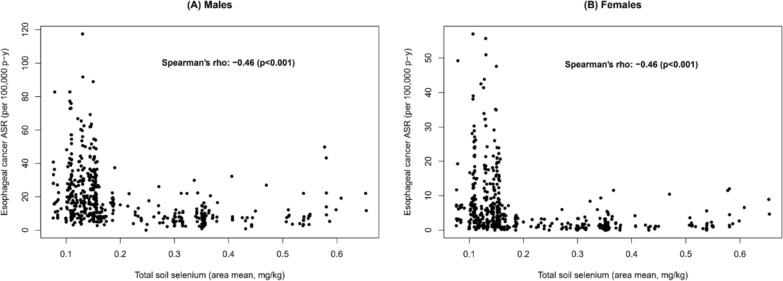 Figure 3
Peer Reviews
No public reviews on file for this paper yet. If you reviewed it on a platform where reviews are public (OpenReview, ICLR, NeurIPS, ICML), you can paste yours below so the community can read it here.
Videos
No videos yet. Explain this paper in a talk, walkthrough, or lecture? Add one.
Taxonomy
TopicsSelenium in Biological Systems · Arsenic contamination and mitigation · Heavy Metal Exposure and Toxicity