Is modernization widening cultural differences?
Thomas Talhelm

TL;DR
The paper argues that modernization may be increasing cultural differences rather than reducing them, based on evidence from the World Values Survey.
Contribution
It introduces a new 'seed model' to explain how modernization interacts with pre-existing cultural values.
Findings
Nations are becoming more different in their values over 40 years of the World Values Survey.
Modernization can amplify existing cultural differences rather than homogenize them.
The seed model provides a new framework to understand cultural changes beyond classic modernization theory.
Abstract
Some researchers have argued that modernization is making cultures more individualistic and shrinking cultural differences. Here, I points to counterintuitive new evidence that modernization is increasing some cultural differences. For example, across the 40 years of the World Values Survey, nations are becoming more different in their values, rather than more similar. I propose that modernization sometimes acts like water on a seed, giving people resources that they decide to use in ways that depend on their pre-existing values and beliefs. The seed model offers a framework for understanding findings that do not fit classic modernization theory from domains of psychology to behavioral genetics. I outline critical questions that this model needs to answer if it is to become useful, such as where the seeds of culture come from and when we should predict decreasing versus increasing…
Click any figure to enlarge with its caption.
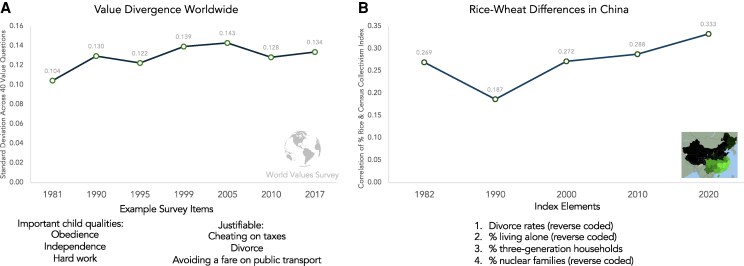 Figure 1
Peer Reviews
No public reviews on file for this paper yet. If you reviewed it on a platform where reviews are public (OpenReview, ICLR, NeurIPS, ICML), you can paste yours below so the community can read it here.
Videos
No videos yet. Explain this paper in a talk, walkthrough, or lecture? Add one.
Taxonomy
TopicsCultural Differences and Values · Culture, Economy, and Development Studies · Language and cultural evolution