Revisiting the TSH range in older adults: associations between subclinical hypothyroidism and geriatric conditions
Toshiki Kogai, Hideyoshi Kaga, Toyoyoshi Uchida, Hitoshi Naito, Yuki Someya, Hiroki Tabata, Saori Kakehi, Tsubasa Tajima, Naoaki Ito, Satoshi Kadowaki, Yuya Nishida, Ryuzo Kawamori, Hirotaka Watada, Yoshifumi Tamura

TL;DR
This study suggests that adjusting the TSH reference range for older adults could prevent overdiagnosis of subclinical hypothyroidism, as mild cases are not linked to geriatric conditions.
Contribution
The study evaluates age-specific TSH reference ranges and their associations with geriatric conditions in older adults.
Findings
Moderate-to-severe subclinical hypothyroidism is associated with cerebral microbleeds and sarcopenia in older adults.
Mild subclinical hypothyroidism is not significantly linked to geriatric conditions.
TSH levels increase with age while free triiodothyronine decreases in older adults.
Abstract
Thyroid-stimulating hormone (TSH) levels physiologically increase with age. Applying a fixed adult reference range to older adults may cause overdiagnosis of subclinical hypothyroidism (SCH). This study examined whether adjusting the upper limit of the TSH reference range is appropriate by evaluating reference ranges and risks of geriatric conditions in older adults. We analyzed 1626 community-dwelling adults aged 65-84 years from the Bunkyo Health Study. Reference ranges for TSH, free triiodothyronine (FT3), and free thyroxine (FT4) were calculated using the 2.5th-97.5th percentiles. Participants with normal FT4 were classified into 3 groups by TSH: euthyroid (0.61-4.23 mIU/L), mild SCH (>4.23 to <7.0 mIU/L), and moderate-to-severe SCH (≥7.0 mIU/L). Associations between TSH categories and geriatric conditions were evaluated using logistic regression. With increasing age, TSH tended…
Genes, proteins, chemicals, diseases, species, mutations and cell lines named across the full text — each resolved to its canonical identifier and authoritative record.
Click any figure to enlarge with its caption.
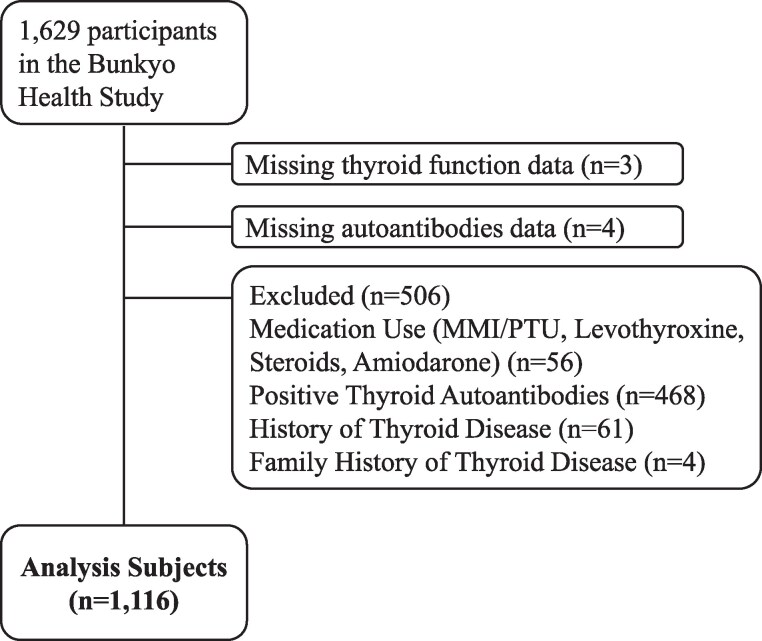 Figure 1
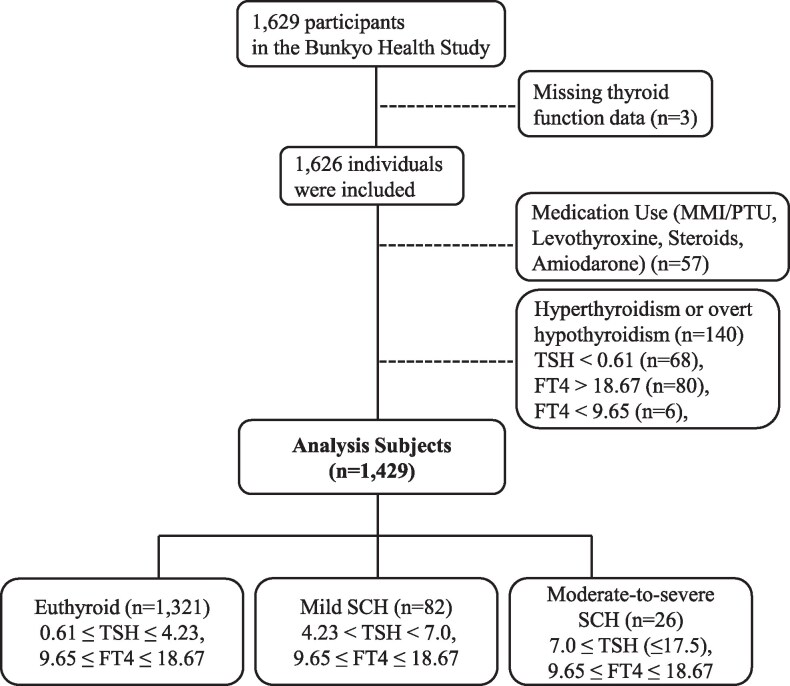 Figure 2
Peer Reviews
No public reviews on file for this paper yet. If you reviewed it on a platform where reviews are public (OpenReview, ICLR, NeurIPS, ICML), you can paste yours below so the community can read it here.
Videos
No videos yet. Explain this paper in a talk, walkthrough, or lecture? Add one.
Taxonomy
TopicsThyroid Disorders and Treatments · Thyroid Cancer Diagnosis and Treatment · Ophthalmology and Eye Disorders