Donor-Derived Cell-Free DNA as a Non-Invasive Readout of Activity Across the Rejection Continuum
Louise Benning, Aylin Akifova, Bilgin Osmanodja, Christian Morath, Julia Beck, Ekkehard Schütz, Klemens Budde

TL;DR
This study shows that donor-derived cell-free DNA can non-invasively track kidney transplant rejection, especially in severe cases like antibody-mediated rejection.
Contribution
The paper introduces a combined model of dd-cfDNA measures that better reflects rejection activity than traditional methods.
Findings
dd-cfDNA levels increase with histopathological rejection activity, especially in antibody-mediated rejection.
The combined model (CM) score outperforms absolute and relative dd-cfDNA measures in correlating with rejection indices.
Low-grade T-cell-mediated rejection shows lower and more variable dd-cfDNA levels.
Abstract
Recent work demonstrated that kidney allograft rejection unfolds along a biological continuum that can be quantified using histopathology-derived continuous indices. To investigate whether donor-derived cell-free DNA (dd-cfDNA) reflects this rejection continuum and complements these histopathology-derived indices, we analyzed the association between dd-cfDNA measures and the newly developed rejection indices in 249 indication biopsies from two independent cohorts. dd-cfDNA was analyzed as percentage, absolute copies/mL, and as a previously developed combined continuous model (CM) score integrating both measures to mitigate limitations of relative measurements. dd-cfDNA increased with histopathological activity and was highest in biopsies with microvascular inflammation (MVI), including antibody-mediated (AMR) and mixed rejection, paralleling high AMR/MVI and activity indices.…
Genes, proteins, chemicals, diseases, species, mutations and cell lines named across the full text — each resolved to its canonical identifier and authoritative record.
Click any figure to enlarge with its caption.
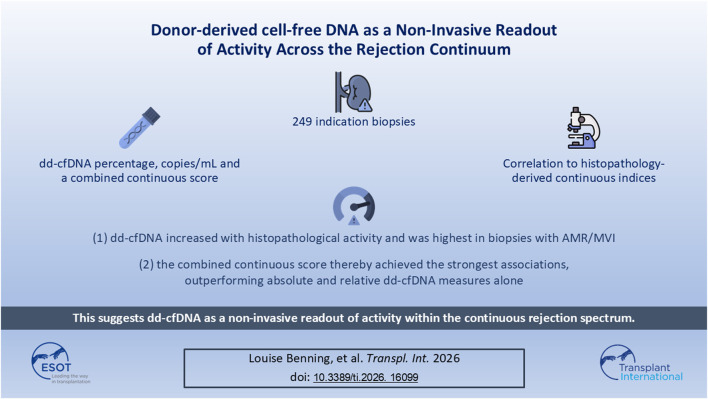 Figure 1
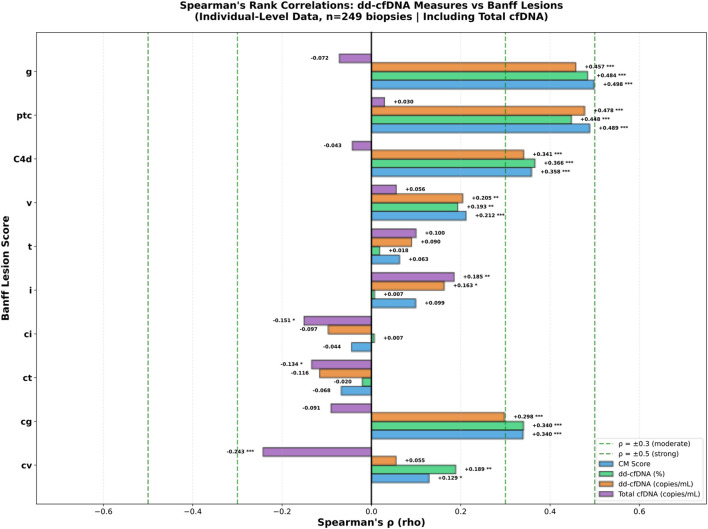 Figure 2
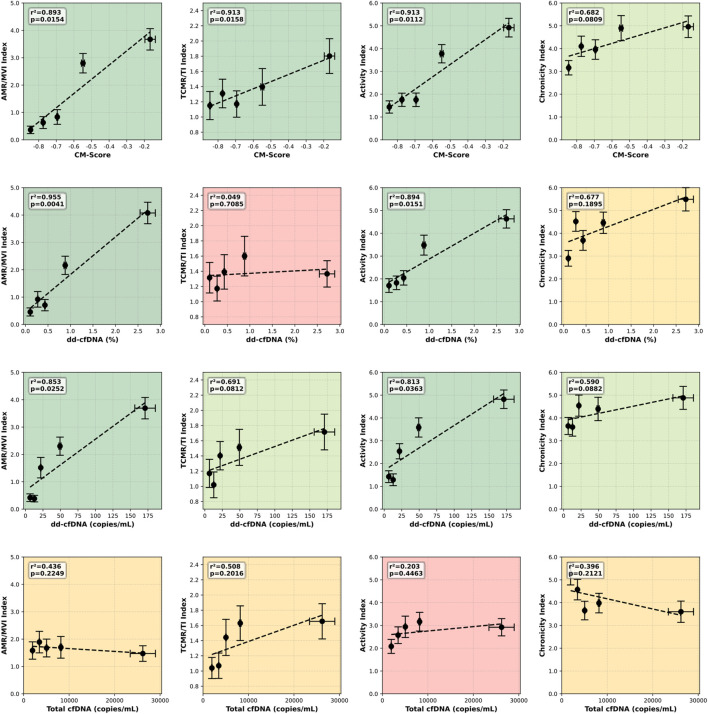 Figure 3
Peer Reviews
No public reviews on file for this paper yet. If you reviewed it on a platform where reviews are public (OpenReview, ICLR, NeurIPS, ICML), you can paste yours below so the community can read it here.
Videos
No videos yet. Explain this paper in a talk, walkthrough, or lecture? Add one.
Taxonomy
TopicsRenal Transplantation Outcomes and Treatments · Cancer Genomics and Diagnostics · Organ Donation and Transplantation