A Chromosome-level Assembly and Functional Genomic Resources for the Model Annelid Capitella teleta
Billie E Davies, Paul Gonzalez, Abhinav Sur, Jingcheng Wei, Tom Frankish, Jimena Montagne, Allan M Carrillo-Baltodano, Kero Guynes, Yan Liang, Rory D Donnellan, R Travis Moreland, Sumeeta Singh, Suiyuan Zhang, Reynold Yu, Tyra G Wolfsberg, Néva P Meyer, Elaine C Seaver

TL;DR
This study creates a high-quality chromosome-level genome assembly for the annelid Capitella teleta, improving genomic resources for research in evolution and development.
Contribution
A new chromosome-level genome assembly and functional genomic tools for Capitella teleta using modern sequencing and chromatin capture techniques.
Findings
The new reference assembly accurately reflects the expected genome size and gene repertoire.
Nuclear and mitochondrial genomes show heavy rearrangements, decoupling gene family evolution from chromosomal structure.
Improved RNA-seq and epigenomic data analysis enabled identification of new cell-type-specific gene markers.
Abstract
The polychaete Capitella teleta is a primary model for evolutionary developmental biology, comparative genomics, conservation, and ecotoxicology. Although it was the first polychaete genome sequenced, the original assembly is outdated by modern standards. Here, we combine long-read and short-read sequencing with Hi-C chromatin conformation capture to assemble chromosome-level nuclear and mitochondrial genomes of the laboratory strain of C. teleta. This reference assembly accurately reflects the expected genome size (∼243.6 Mb) and contains a highly complete, evolutionarily conserved gene repertoire. Notably, the nuclear and mitochondrial genomes are heavily rearranged, indicating a decoupling between gene family repertoire and chromosomal evolution. The analyses of developmental time courses of bulk and single-cell RNA-seq, ATAC-seq, and EM-seq data using the new reference assembly…
Genes, proteins, chemicals, diseases, species, mutations and cell lines named across the full text — each resolved to its canonical identifier and authoritative record.
Click any figure to enlarge with its caption.
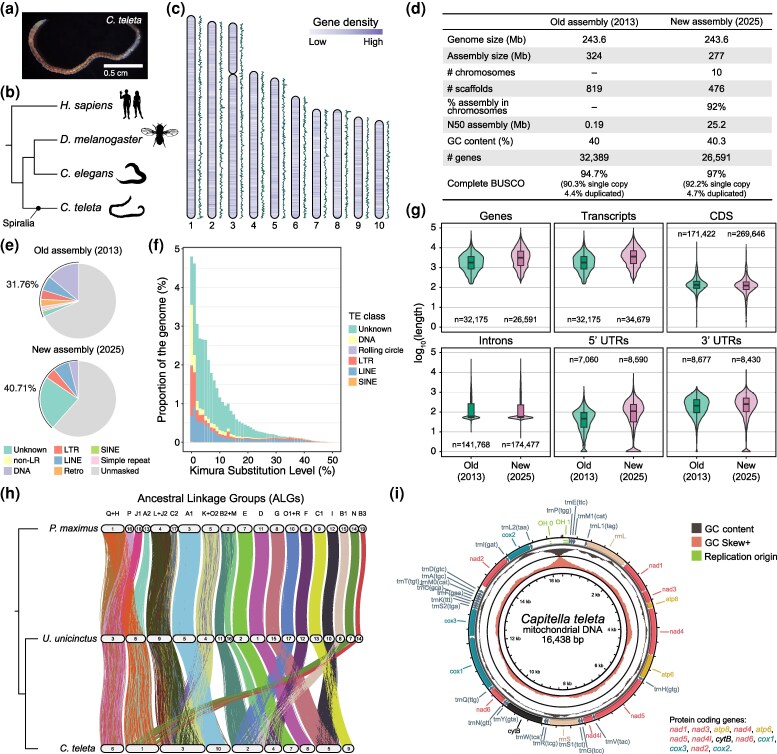 Figure 1
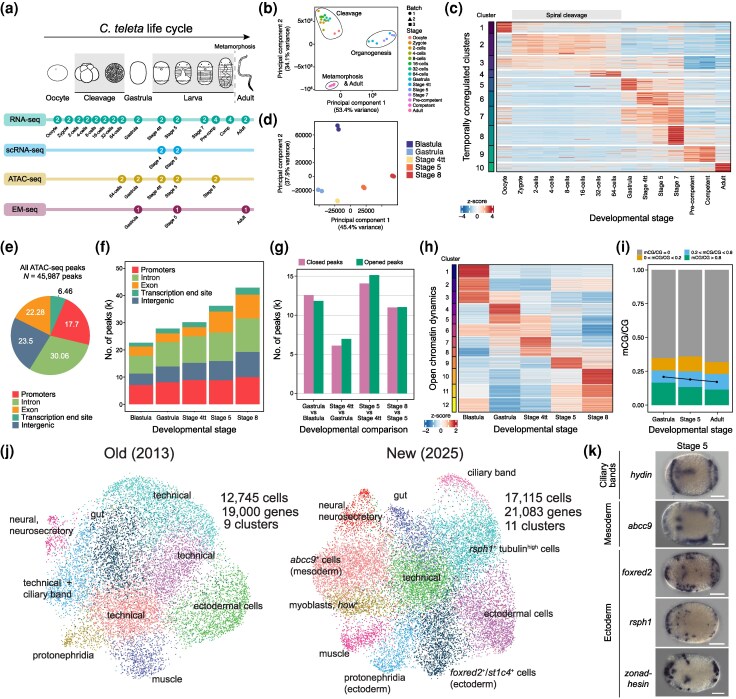 Figure 2
Peer Reviews
No public reviews on file for this paper yet. If you reviewed it on a platform where reviews are public (OpenReview, ICLR, NeurIPS, ICML), you can paste yours below so the community can read it here.
Videos
No videos yet. Explain this paper in a talk, walkthrough, or lecture? Add one.
Taxonomy
TopicsGenomics and Phylogenetic Studies · Protist diversity and phylogeny · Environmental DNA in Biodiversity Studies