Longitudinal association between sleep and Alzheimer's pathology
Bery Mohammediyan, Andrée‐Ann Baril, Alfonso Fajardo Valdez, Frédéric St‐Onge, Alexa Pichet Binette, Julie Carrier, Maiya R. Geddes, Simon Ducharme, Maxime Montembeault, Jean‐Paul Soucy, John Breitner, Judes Poirier, Sylvia Villeneuve

TL;DR
Irregular sleep patterns in older adults are linked to early signs of Alzheimer's disease, suggesting sleep could be a target for prevention.
Contribution
This study identifies sleep variability as a novel early marker of Alzheimer's pathology in cognitively unimpaired individuals.
Findings
Greater sleep variability is associated with higher amyloid and tau burden in preclinical Alzheimer's.
Variability in sleep efficiency predicts faster amyloid accumulation over time.
Sleep irregularity may serve as a sensitive marker of preclinical Alzheimer's pathophysiology.
Abstract
Since sleep disturbance is a modifiable risk factor for Alzheimer's disease (AD), we tested associations between sleep and AD pathology in cognitively unimpaired (CU) persons. We included 223 participants from the PREVENT‐AD cohort with self‐reported measures of sleep, objective actigraphy measures of sleep, and positron emission tomography (PET) scans for AD pathology quantification. Repeated PET scans (mean follow‐up: 4.31 ± 0.55 years) were available for 103 participants. We conducted robust linear models (RLM) for cross‐sectional analyses and RLMs using the annual change in AD pathology for longitudinal analyses. All actigraphy‐based sleep variability measures were associated with tau burden (duration: β = 0.121 [95% confidence interval {CI} = 0.010; 0.232], p = 0.034; efficiency: 0.122 [0.010; 0.235], 0.033; fragmentation: 0.115 [0.010; 0.221], 0.033). Greater variability in…
Genes, proteins, chemicals, diseases, species, mutations and cell lines named across the full text — each resolved to its canonical identifier and authoritative record.
Click any figure to enlarge with its caption.
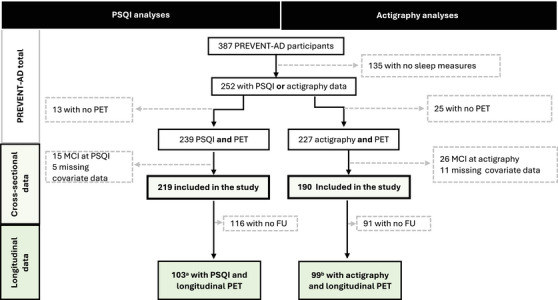 Figure 1
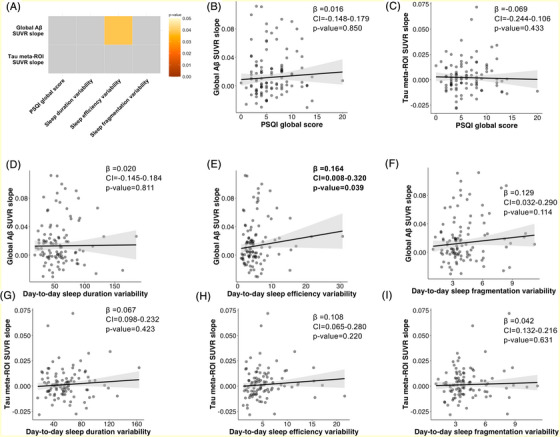 Figure 2
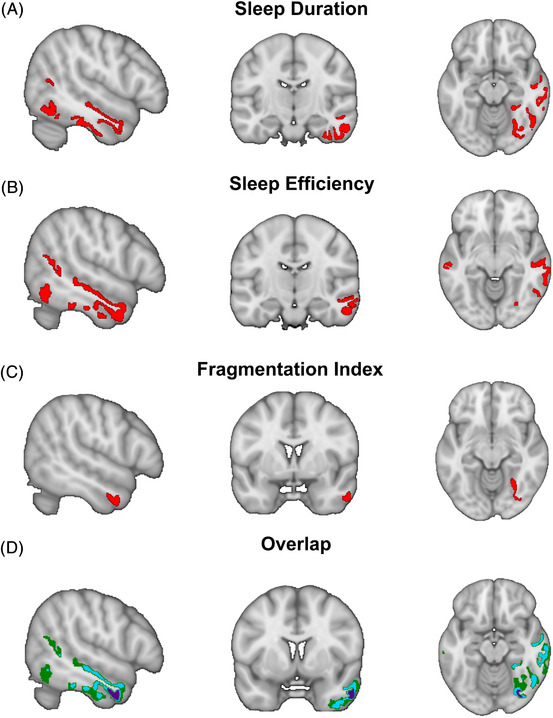 Figure 3
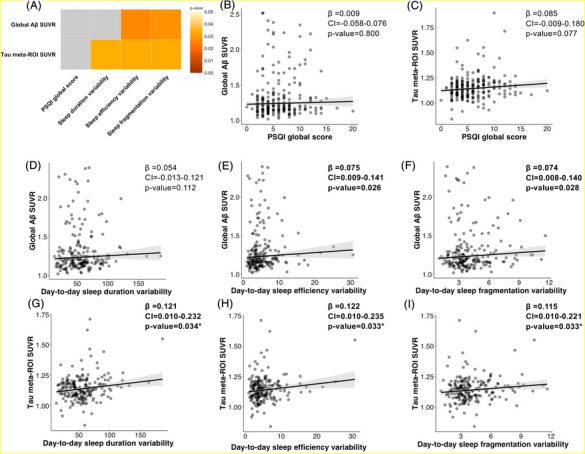 Figure 4
Peer Reviews
No public reviews on file for this paper yet. If you reviewed it on a platform where reviews are public (OpenReview, ICLR, NeurIPS, ICML), you can paste yours below so the community can read it here.
Videos
No videos yet. Explain this paper in a talk, walkthrough, or lecture? Add one.
Taxonomy
TopicsSleep and related disorders · Sleep and Wakefulness Research · Restless Legs Syndrome Research