Longitudinal plasma interleukin‐6 and post‐stroke cognitive outcomes: The Stroke‐IMPaCT study
Natasha S. Carmichael, Harry R. Deijnen, Siew Yan Wong, Thomas O. Williams, Evangelos Kontopantelis, Luke Cowie, Eileen Jones, Lauren Drag, Marion S. Buckwalter, John R. Grainger, Stuart M. Allan, Craig J. Smith

TL;DR
High levels of interleukin-6 in the months after a stroke are linked to worse long-term cognitive outcomes, suggesting a potential target for treatment.
Contribution
This study identifies rising interleukin-6 levels as a stronger predictor of post-stroke cognitive decline than initial levels.
Findings
A doubling of IL-6 between admission and 6–9 months was associated with cognitive impairment at 18–21 months.
Smoking was linked to lower IL-6 levels and reduced Toll-like receptor signaling.
Subacute IL-6 changes may help predict or guide interventions for cognitive outcomes after stroke.
Abstract
Inflammatory factors, particularly interleukin (IL)‐6, are implicated in post‐stroke cognitive decline, yet the association with longitudinal changes in these markers remains unclear. Plasma IL‐6 and other inflammatory markers were measured within 96 hours of ischemic stroke, and at 6–9 and 18–21 months, alongside cognitive assessment. Associations between inflammatory factors and cognition were examined using adjusted regression models. A doubling of IL‐6 between admission and 6–9 months was associated with cognitive impairment at 18–21 months (odds ratio [OR] = 8.16; 95% confidence interval [CI] 1.82–47.26; p = 0.01), while each one‐unit IL‐6 increase was linked to a 1.5‐point decrease in memory Z‐scores (β = ‐1.50; 95% CI ‐2.57–0.43; p = 0.007). Smokers showed persistently blunted IL‐6 trajectories (p < 0.05) and downregulated Toll‐like receptor signaling (p < 0.05). Exploratory…
Genes, proteins, chemicals, diseases, species, mutations and cell lines named across the full text — each resolved to its canonical identifier and authoritative record.
Click any figure to enlarge with its caption.
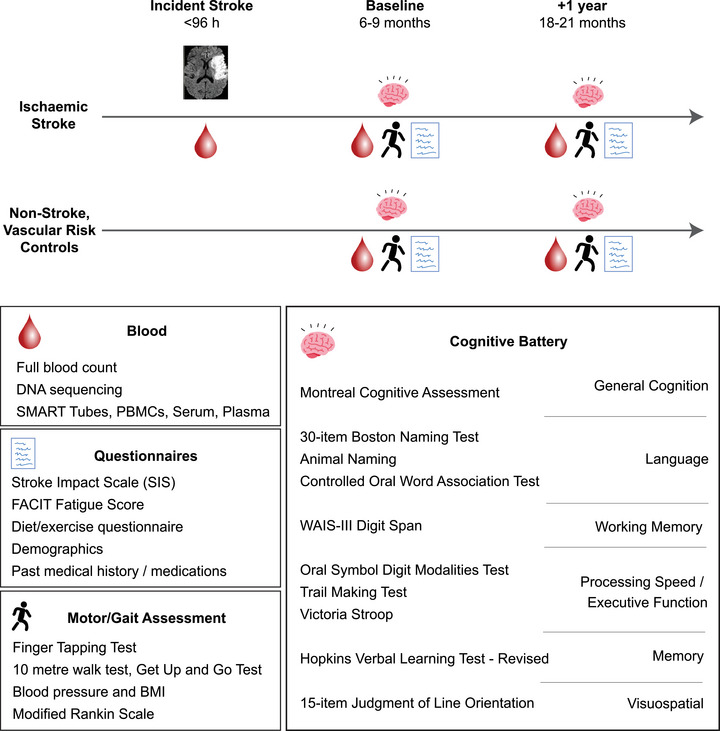 Figure 1
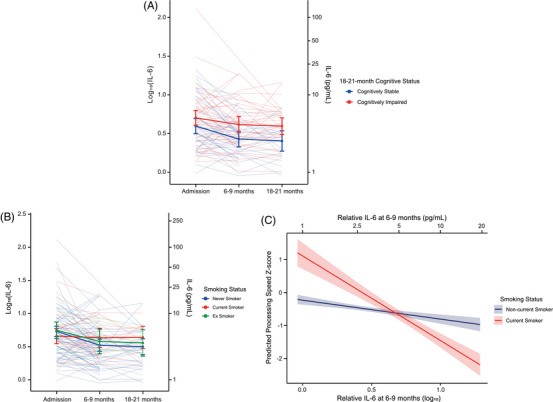 Figure 2
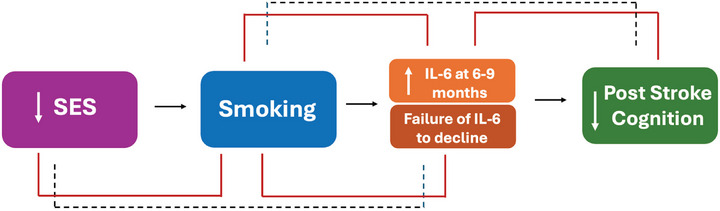 Figure 3
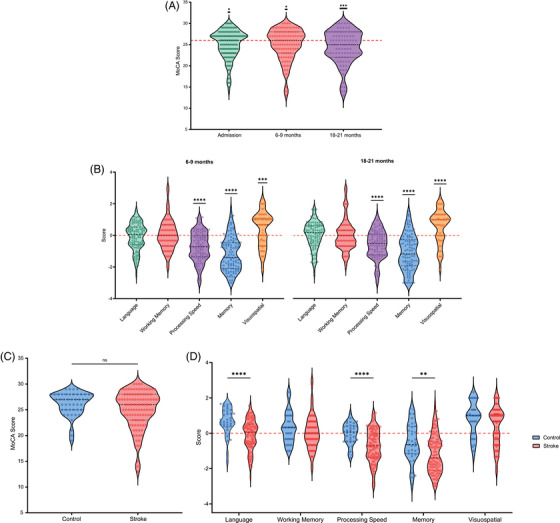 Figure 4
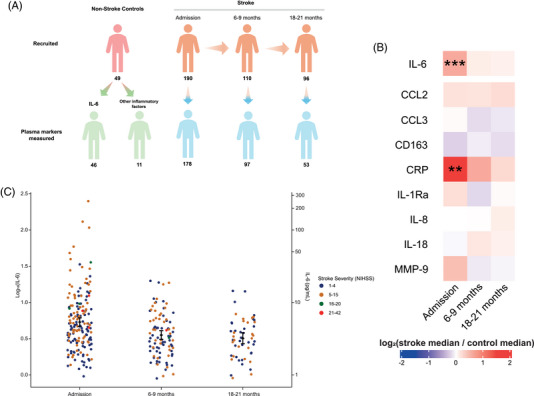 Figure 5
Peer Reviews
No public reviews on file for this paper yet. If you reviewed it on a platform where reviews are public (OpenReview, ICLR, NeurIPS, ICML), you can paste yours below so the community can read it here.
Videos
No videos yet. Explain this paper in a talk, walkthrough, or lecture? Add one.
Taxonomy
TopicsNeuroinflammation and Neurodegeneration Mechanisms · Neurological Disease Mechanisms and Treatments · Adipokines, Inflammation, and Metabolic Diseases