The impact of less severe intimate partner aggression on child conduct problems
Hedwig Eisenbarth, Karina Clavijo Saldias, Paul E. Jose, Johannes A. Karl, Karen E. Waldie

TL;DR
Children exposed to less severe forms of intimate partner aggression are more likely to develop conduct problems, with effects that persist into childhood and are only partly explained by maternal depression.
Contribution
This study demonstrates that even less severe forms of intimate partner aggression impact child conduct problems, independent of maternal depression and unaffected by maternal warmth.
Findings
Intimate partner aggression predicts child conduct problems at different ages, regardless of the reporter.
Maternal depression partially mediates the effect of intimate partner aggression on child conduct problems.
Maternal warmth does not moderate the negative impact of intimate partner aggression on child behavior.
Abstract
Significant intimate partner aggression (IPA) has been found to negatively impact outcomes of children, such as increased conduct problems (CP). However, it is unclear if forms of IPA that are less severe (e.g., shoving, pushing or yelling) have no, little, or substantial impact on child CP, which would indicate that the intensity (i.e., dosage) of IPA matters. In addition, it is unknown if the impact of IPA on child CP depends on the reporter (mother vs. partner) and on variables such as maternal depression and parenting. We investigated the impact of IPA (both mother‐ and partner‐reported), assessed during pregnancy and 9 months postpartum, on child CP at ages 2, 4.5, and 8 years. We also tested both the potential mediating role of maternal depression and moderating role of maternal warmth, reflecting risk and protective factors, respectively. Using longitudinal data from the Growing…
Genes, proteins, chemicals, diseases, species, mutations and cell lines named across the full text — each resolved to its canonical identifier and authoritative record.
Click any figure to enlarge with its caption.
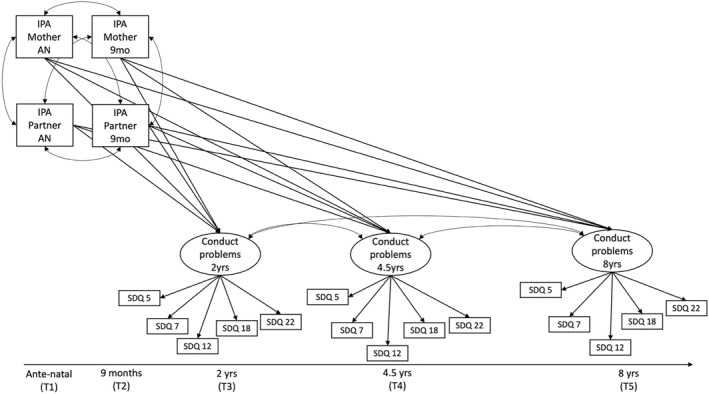 Figure 1
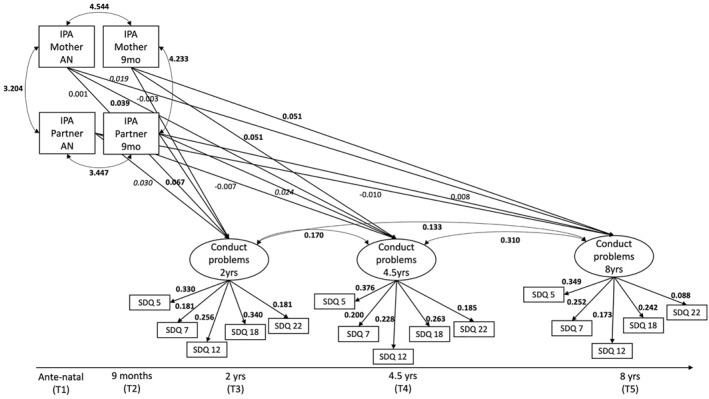 Figure 2
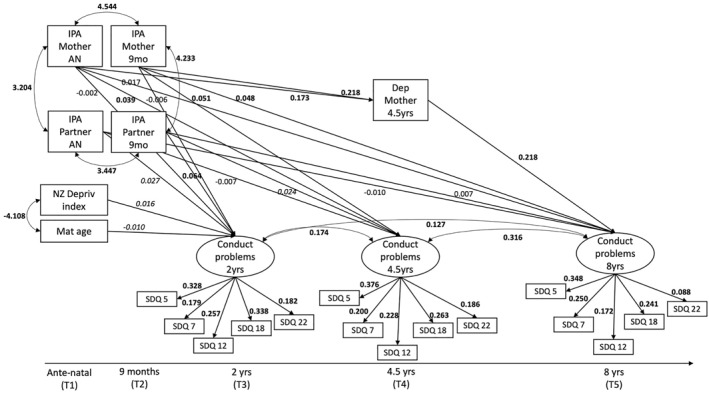 Figure 3
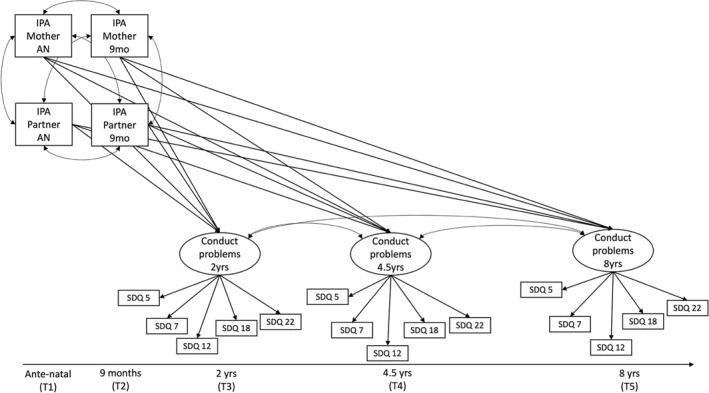 Figure 4
Peer Reviews
No public reviews on file for this paper yet. If you reviewed it on a platform where reviews are public (OpenReview, ICLR, NeurIPS, ICML), you can paste yours below so the community can read it here.
Videos
No videos yet. Explain this paper in a talk, walkthrough, or lecture? Add one.
Taxonomy
TopicsIntimate Partner and Family Violence · Child Abuse and Trauma · Homicide, Infanticide, and Child Abuse