High-Frequency Oscillation vs Mechanical Ventilation for Neonatal Acute Respiratory Distress Syndrome: A Randomized Clinical Trial
Jie Li, Kaizhen Liu, Qian Yang, Qin Tan, Zhichun Feng, Yuan Shi, Long Chen, Ling-Jun Li

TL;DR
A clinical trial found that high-frequency oscillatory ventilation may reduce the risk of a chronic lung disease in preterm infants with respiratory distress syndrome compared to traditional ventilation.
Contribution
This study provides new evidence that elective high-frequency oscillatory ventilation reduces bronchopulmonary dysplasia in preterm infants with acute respiratory distress syndrome.
Findings
Elective HFOV reduced BPD by 8.0% using the 2001 NICHD definition and by 32.0% using the 2019 definition compared to CMV.
No significant differences were found between groups for death or other major neonatal complications.
Sensitivity analysis confirmed the robustness of the BPD reduction findings.
Abstract
Does elective high-frequency oscillatory ventilation (HFOV) reduce the incidence of bronchopulmonary dysplasia (BPD) and other neonatal adverse outcomes compared with conventional mechanical ventilation (CMV) among preterm infants diagnosed with neonatal acute respiratory distress syndrome? In this randomized clinical trial of 386 preterm infants, elective HFOV reduced the risk of BPD according to the 2001 Eunice Kennedy Shriver National Institute of Child Health and Human Development definition by 8.0% and the risk of BPD according to the 2019 Jensen definition by 32.0% compared with CMV. The results of this study suggest that elective HFOV is a promising strategy for preventing BPD in preterm infants with neonatal acute respiratory distress syndrome, especially the more severe forms associated with increased long-term morbidity and mortality. This randomized clinical trial compares…
Genes, proteins, chemicals, diseases, species, mutations and cell lines named across the full text — each resolved to its canonical identifier and authoritative record.
Click any figure to enlarge with its caption.
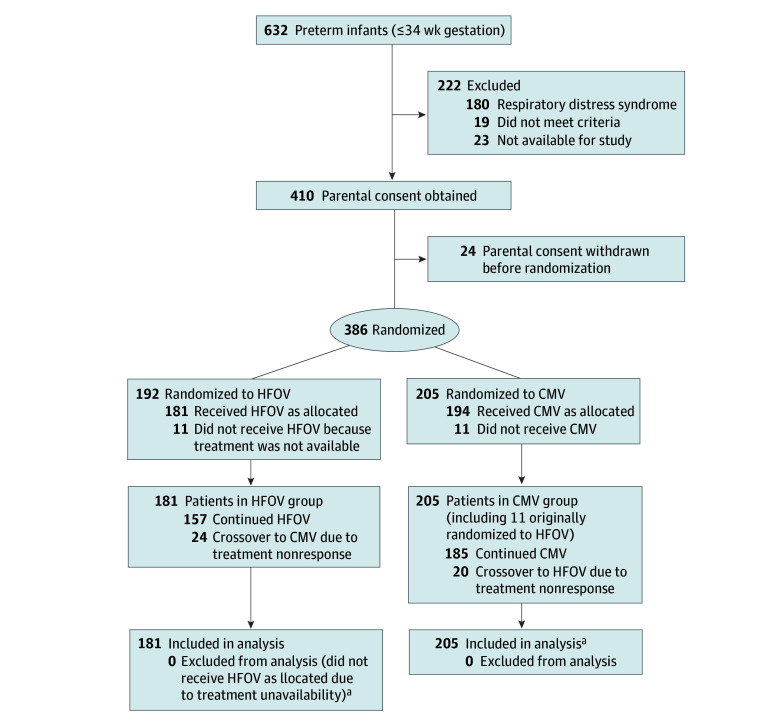 Figure 1
Peer Reviews
No public reviews on file for this paper yet. If you reviewed it on a platform where reviews are public (OpenReview, ICLR, NeurIPS, ICML), you can paste yours below so the community can read it here.
Videos
No videos yet. Explain this paper in a talk, walkthrough, or lecture? Add one.
Taxonomy
TopicsNeonatal Respiratory Health Research · Respiratory Support and Mechanisms · Neuroscience of respiration and sleep