Neurod2 knockdown in Xenopus laevis tadpole brain retains cells in a proliferating, progenitor-like state
Caroline W Beck, Sulagna Banerjee, Robert C Day

TL;DR
Reducing Neurod2 in Xenopus tadpoles stops brain cells from maturing and causes seizures, suggesting a role in neural development.
Contribution
This study reveals that Neurod2 deficiency retains progenitor cells in a proliferative state, linking it to hyper-excitability and seizures.
Findings
Neurod2 knockdown increases cell cycle gene expression in tadpole brains.
Neurod2 deficiency decreases nerve growth factor and chromatin modifying gene expression.
Loss of Neurod2 prevents neural progenitor cells from differentiating and exiting the cell cycle.
Abstract
Neurogenic differentiation factor 2, encoded by the NEUROD2 gene, is a proneural transcription factor required for neuronal differentiation and survival. Haploinsufficiency of NEUROD2 can cause neurodevelopmental disorders with or without seizures in human infants and causes spontaneous seizures in Xenopus tadpoles. We compared transcriptomes of whole brains dissected from F 0 neurod2 -/- (mosaic) stage NF47 Xenopus laevis tadpoles to those of control siblings. neurod2 knockdown increased expression of cell cycle-associated genes and decreased nerve growth factor (NGF) and chromatin modifying genes. Our results suggest Neurod2 deficiency prevents neural progenitor cells exiting the cell cycle and differentiating, predisposing the brain to hyper-excitability.
Genes, proteins, chemicals, diseases, species, mutations and cell lines named across the full text — each resolved to its canonical identifier and authoritative record.
Click any figure to enlarge with its caption.
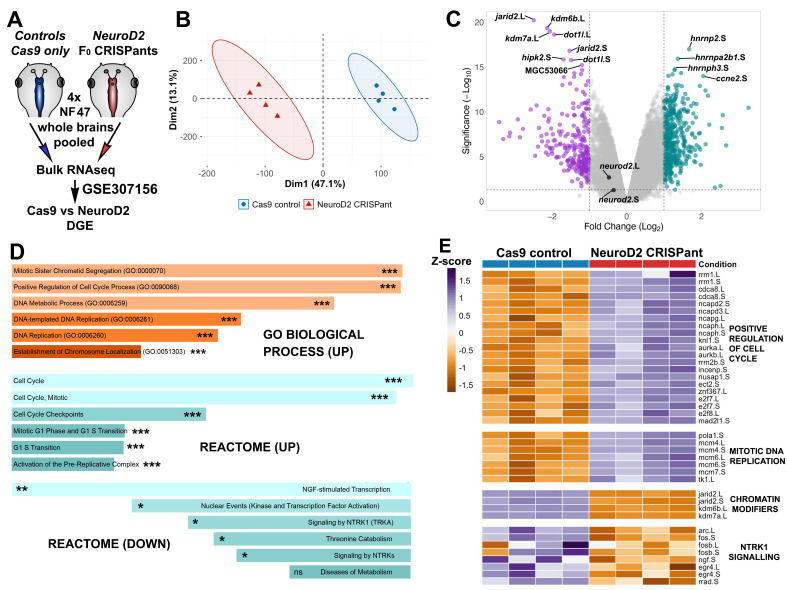 Figure 1
Peer Reviews
No public reviews on file for this paper yet. If you reviewed it on a platform where reviews are public (OpenReview, ICLR, NeurIPS, ICML), you can paste yours below so the community can read it here.
Videos
No videos yet. Explain this paper in a talk, walkthrough, or lecture? Add one.
Taxonomy
TopicsNeurogenesis and neuroplasticity mechanisms · Developmental Biology and Gene Regulation · Nuclear Receptors and Signaling