The N-terminal α helix domain of the mitochondrial VDAC protein Por2 is dispensable for promoting the nuclear localization of yeast AMPK
Kerry Brown, Hemanth Singuluri, Frank Perkins, Sergei Kuchin

TL;DR
This study shows that a specific part of the Por2 protein in yeast is not needed for moving a key energy-sensing protein into the nucleus.
Contribution
The study reveals that the N-terminal α helix domain of Por2 is not essential for Snf1 nuclear localization in yeast.
Findings
The N-terminal α helix domain of Por2 is not required for Snf1 nuclear translocation.
Further experiments are needed to clarify the role of Por1/2 NAH domains in Snf1 signaling.
Abstract
In yeast, the mitochondrial voltage-dependent anion channel (VDAC) proteins Por1 and Por2 play regulatory roles in the regulation of Snf1, an ortholog of AMP-activated protein kinase (AMPK). An important question is whether Por1 and Por2 serve as Snf1-coupled energy sensors. VDACs are β-barrel proteins, but they have a flexibly-linked N-terminal α helix (NAH) domain, suggesting a possible role in Snf1 signaling. Here, we asked whether the NAH domain of Por2 is required for promoting Snf1 nuclear translocation. In our experimental setup, the Por2 NAH was dispensable. Further experiments are required to fully understand the regulatory roles of the Por1/2 NAH domains.
Genes, proteins, chemicals, diseases, species, mutations and cell lines named across the full text — each resolved to its canonical identifier and authoritative record.
Click any figure to enlarge with its caption.
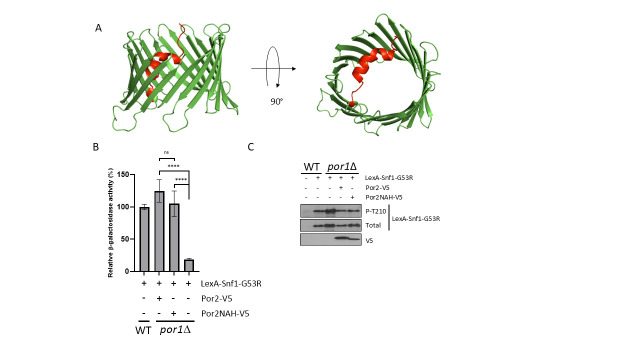 Figure 1
Peer Reviews
No public reviews on file for this paper yet. If you reviewed it on a platform where reviews are public (OpenReview, ICLR, NeurIPS, ICML), you can paste yours below so the community can read it here.
Videos
No videos yet. Explain this paper in a talk, walkthrough, or lecture? Add one.
Taxonomy
TopicsMetabolism, Diabetes, and Cancer · Mitochondrial Function and Pathology · Calcium signaling and nucleotide metabolism