Shorter epinephrine dosing intervals and one-year survival after in-hospital pediatric cardiopulmonary resuscitation
Bruno Marcelo Herculano Moura, Edison Ferreira de Paiva, Ivan Peres Costa, Thomaz Bittencourt Couto, Cláudio Schvartsman, Tania Miyuki Shimoda Sakano, Amelia Gorete Reis

TL;DR
This study examines how the timing of epinephrine doses affects survival and neurological outcomes in children who experience cardiac arrest in the hospital.
Contribution
The study is one of the first to investigate the association between epinephrine dosing intervals and one-year survival in pediatric in-hospital cardiac arrest.
Findings
Shorter epinephrine dosing intervals were associated with increased one-year survival in univariate analysis.
Multivariable analysis showed that longer dosing intervals and other factors were linked to reduced survival.
No significant association was found between epinephrine dosing intervals and neurological outcomes.
Abstract
To evaluate the association between the interval doses of epinephrine and one-year survival and one-year neurological prognosis after pediatric in-hospital cardiac arrest (IHCA). This observational retrospective cohort study included pediatric patients (0–18 years) who experienced IHCA and received at least two doses of epinephrine from January 2015 to December 2022. Data were collected following the Utstein style. The mean interval between epinephrine doses was categorized as 〈 3, 3–5, or > 5 min. Primary outcome was one-year survival; secondary outcomes were survival to hospital discharge and one-year neurological prognosis, assessed by the Pediatric Cerebral Performance Category. 194 patients were eligible. In the univariate adjusted analysis, patients who received epinephrine at intervals shorter than 3 min had a 2.3-fold increased chance of one-year survival (OR 2.3; 95 % CI…
Genes, proteins, chemicals, diseases, species, mutations and cell lines named across the full text — each resolved to its canonical identifier and authoritative record.
Click any figure to enlarge with its caption.
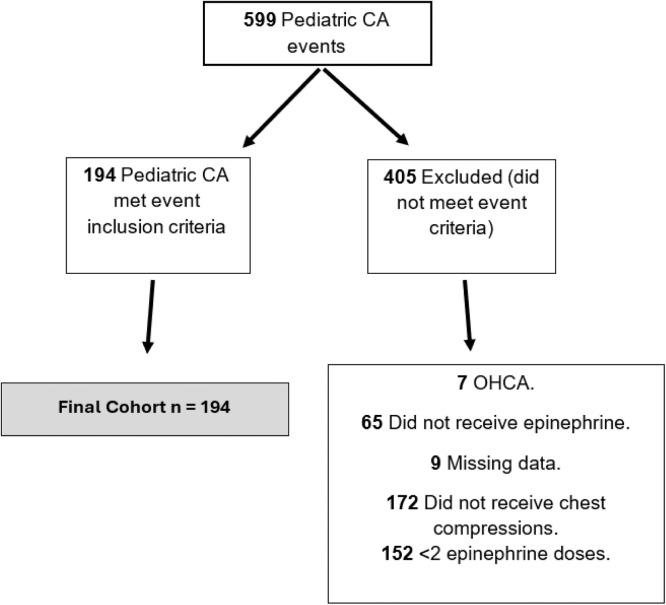 Figure 1
Peer Reviews
No public reviews on file for this paper yet. If you reviewed it on a platform where reviews are public (OpenReview, ICLR, NeurIPS, ICML), you can paste yours below so the community can read it here.
Videos
No videos yet. Explain this paper in a talk, walkthrough, or lecture? Add one.
Taxonomy
TopicsCardiac Arrest and Resuscitation · Sepsis Diagnosis and Treatment · Respiratory Support and Mechanisms