An AI-based intelligent diagnosis system for adolescent mental health based on multitask deep learning
Wenyue Liu, Zhihao Zhang, Linkang Du, Jianguo Qiu

TL;DR
This paper introduces an AI system that uses deep learning to diagnose depression and anxiety in Chinese adolescents based on their written expressions, aiming to overcome limitations of traditional screening methods.
Contribution
The novel contribution is a multitask deep learning system for adolescent mental health diagnosis using textual data, optimized for Chinese cultural and linguistic context.
Findings
The AI system achieved high correlation (0.706 for depression, 0.693 for anxiety) and strong AUC scores (0.877 and 0.902) on test data.
Multitask learning improved performance by 6.2%–7.8% in F1-scores and reduced error by 14.2%–18.4% compared to single-task models.
Data augmentation and adaptations for somatization significantly increased the system’s sensitivity to severe cases.
Abstract
Adolescent depression and anxiety are becoming increasingly prevalent in China, with rates reaching 20%–30%, driven largely by intense academic pressure and the cultural tendency toward somatization. Traditional screening tools, such as the Patient Health Questionnaire-9 (PHQ-9) and Generalized Anxiety Disorder-7 (GAD-7), often suffer from subjective bias, recall errors, and underreporting due to social stigma. This study developed an AI-based intelligent diagnosis system (IDS) using multitask deep learning to non-intrusively predict comorbid depression and anxiety severity based on the spontaneous textual expressions of Chinese adolescents. Textual responses from approximately 1,275 adolescents were collected and labeled with clinician-assessed PHQ-9 and GAD-7 scores. Preprocessing involved jieba segmentation and variational autoencoder (VAE)-based data augmentation to address class…
Genes, proteins, chemicals, diseases, species, mutations and cell lines named across the full text — each resolved to its canonical identifier and authoritative record.
Click any figure to enlarge with its caption.
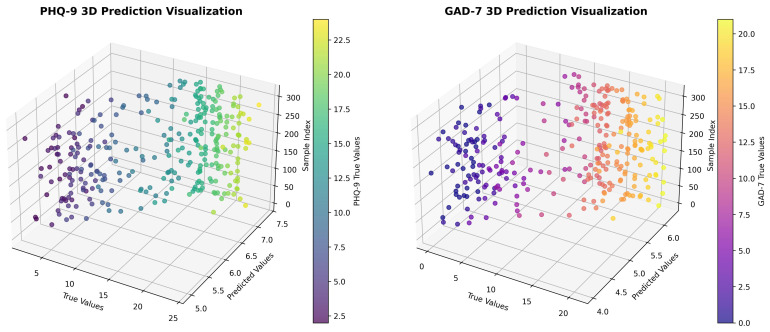 Figure 1
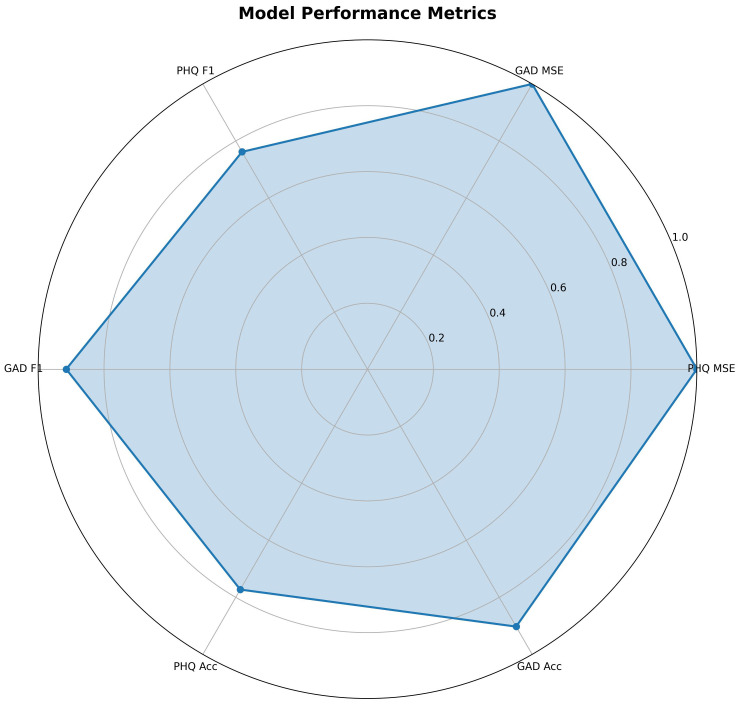 Figure 2
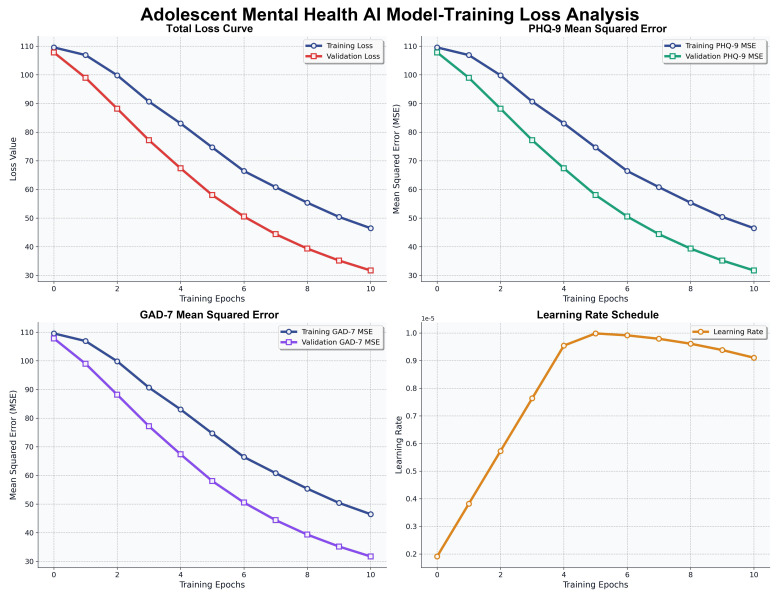 Figure 3
Peer Reviews
No public reviews on file for this paper yet. If you reviewed it on a platform where reviews are public (OpenReview, ICLR, NeurIPS, ICML), you can paste yours below so the community can read it here.
Videos
No videos yet. Explain this paper in a talk, walkthrough, or lecture? Add one.
Taxonomy
TopicsMental Health via Writing · Digital Mental Health Interventions · Emotion and Mood Recognition