Do dysfunctional metacognitive beliefs contribute to interpersonal distress beyond interpersonal styles, parental bonds, depression and anxiety? A prospective within-person study
Eivind R. Strand, Frederick Anyan, Henrik Nordahl

TL;DR
This study explores how dysfunctional metacognitive beliefs affect interpersonal distress over time, beyond factors like anxiety, depression, and parental bonds.
Contribution
The study shows that metacognitive beliefs uniquely predict interpersonal distress over time, independent of other psychological and interpersonal factors.
Findings
Increases in anxiety and depression symptoms predict greater interpersonal distress over time.
Metacognitive belief domains (except cognitive self-consciousness) uniquely predict interpersonal distress trajectories.
Parental bonds and interpersonal style do not predict changes in interpersonal distress over time.
Abstract
General interpersonal problems and distress are transdiagnostic features across the psychopathology spectrum and relate to reduced quality of life, greater emotional symptom severity, and worse outcomes following psychotherapy. Identifying within-person dynamic factors influencing interpersonal distress could therefore advance clinical formulation and intervention, benefiting a large number of patients. Based on a four-wave longitudinal study, we used latent growth modelling to investigate whether metacognitive beliefs, the key mechanism of psychological dysfunction in the metacognitive model, predicted the trajectory of interpersonal distress within individuals over time. We controlled gender, parental bonds to mother and father, and interpersonal style factors agency and communion at baseline, in addition to time-varying changes in anxiety and depression symptoms at the within-person…
Genes, proteins, chemicals, diseases, species, mutations and cell lines named across the full text — each resolved to its canonical identifier and authoritative record.
Click any figure to enlarge with its caption.
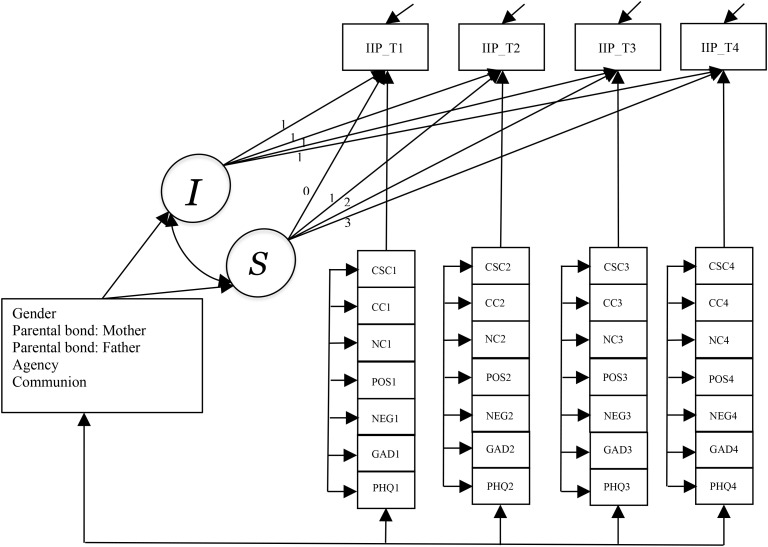 Figure 1
Peer Reviews
No public reviews on file for this paper yet. If you reviewed it on a platform where reviews are public (OpenReview, ICLR, NeurIPS, ICML), you can paste yours below so the community can read it here.
Videos
No videos yet. Explain this paper in a talk, walkthrough, or lecture? Add one.
Taxonomy
TopicsAnxiety, Depression, Psychometrics, Treatment, Cognitive Processes · Mental Health Research Topics · Treatment of Major Depression