Prediction models for high-grade cervical lesions or worse using machine learning
Yunyang Deng, Joakim Dillner, Nicholas Baltzer, Laila Sara Arroyo Mühr, Roxana Merino Martinez, Alexander Ploner, Jiayao Lei, Mark Clements

TL;DR
This study developed machine learning models to predict the risk of high-grade cervical lesions using screening data, aiming to improve cervical cancer screening efficiency.
Contribution
The novel contribution is the development and validation of four machine learning models with varying predictors for predicting cervical lesion risk.
Findings
The models achieved AUCs ranging from 0.83–0.96 in training and test sets.
Model 1 (M1) showed the highest positive predictive value (PPV) across all prediction intervals.
The models demonstrated consistent performance in a separate validation set.
Abstract
This study aimed to improve cervical screening efficiency by developing and validating machine-learning models for predicting high-grade cervical lesions or worse (HCL) risk. From Swedish nationwide registers, we included 474,072 women invited to cervical screening in 2016 (split into 80% training and 20% test sets) and 370,105 women invited in 2017 for validation. All women underwent index cytology and/or human papillomavirus (HPV) testing within the recommended interval after age 29. Predictors included screening results (cytology and/or HPV testing), other HPV-related factors, and demographic factors (including age). Four random forest models were trained via 5-fold cross-validation with different predictors: Model 1 (M1) (all predictors), M2 (cytology, HPV testing, age), M3 (HPV testing, other HPV-related factors, and demographic factors), and M4 (HPV testing and age). We computed…
Genes, proteins, chemicals, diseases, species, mutations and cell lines named across the full text — each resolved to its canonical identifier and authoritative record.
Click any figure to enlarge with its caption.
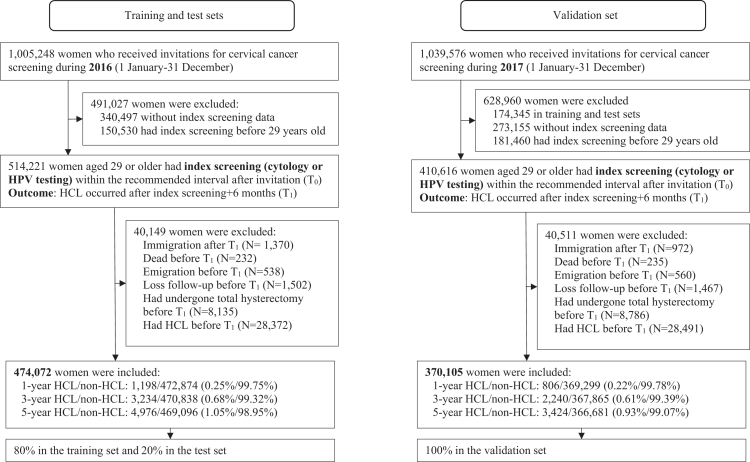 Figure 1
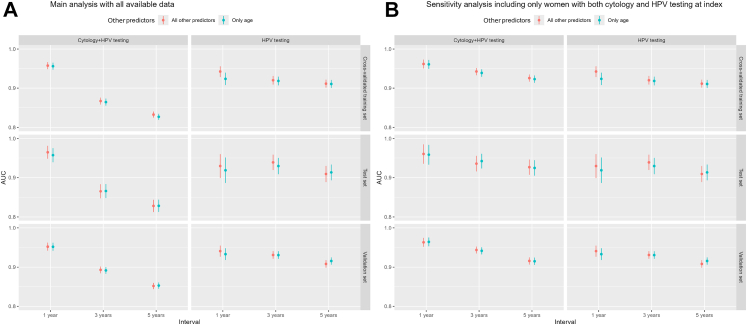 Figure 2
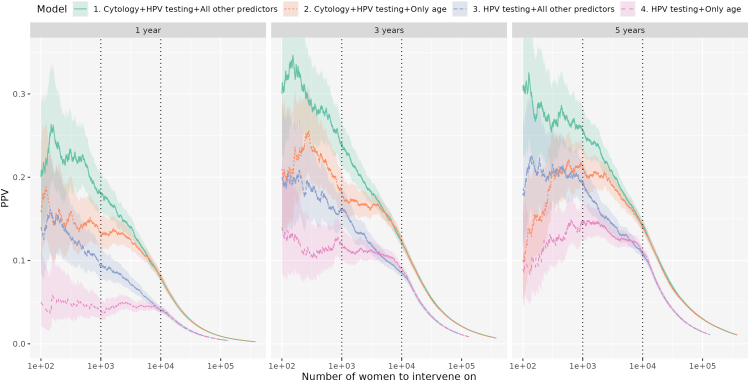 Figure 3
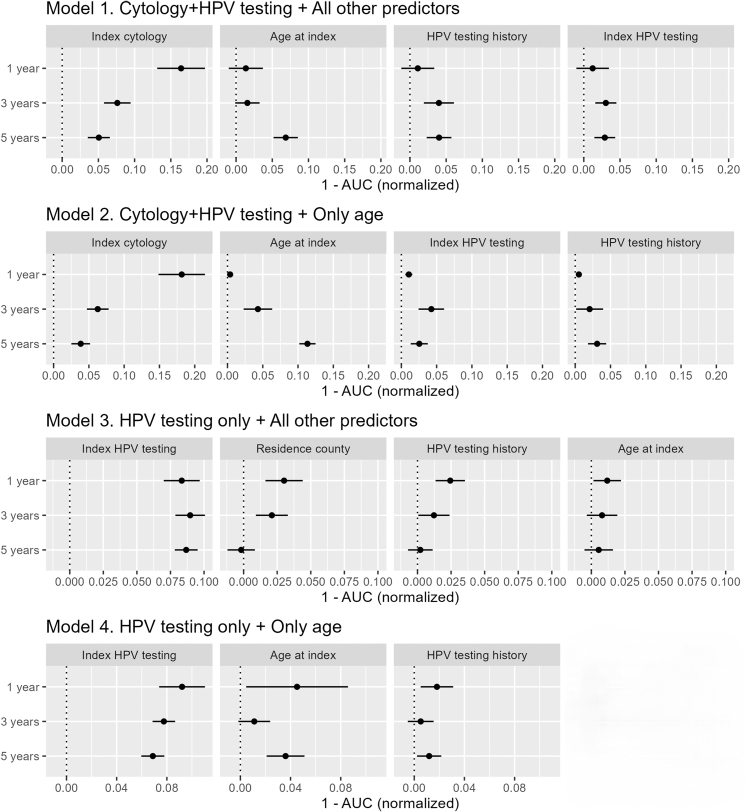 Figure 4
Peer Reviews
No public reviews on file for this paper yet. If you reviewed it on a platform where reviews are public (OpenReview, ICLR, NeurIPS, ICML), you can paste yours below so the community can read it here.
Videos
No videos yet. Explain this paper in a talk, walkthrough, or lecture? Add one.
Taxonomy
TopicsAI in cancer detection · Cervical Cancer and HPV Research · Cervical and Thoracic Myelopathy