Safe retrieval of gastrointestinal foreign bodies using the novel endoscopic attachment with a flower-shaped design
Sara Haruki, Takehiko Koga, Norihiro Kojima, Hiroshi Takamori

Abstract
Genes, proteins, chemicals, diseases, species, mutations and cell lines named across the full text — each resolved to its canonical identifier and authoritative record.
Click any figure to enlarge with its caption.
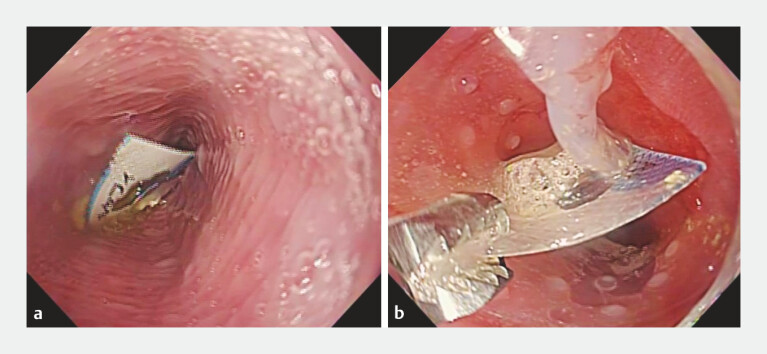 Fig. 1
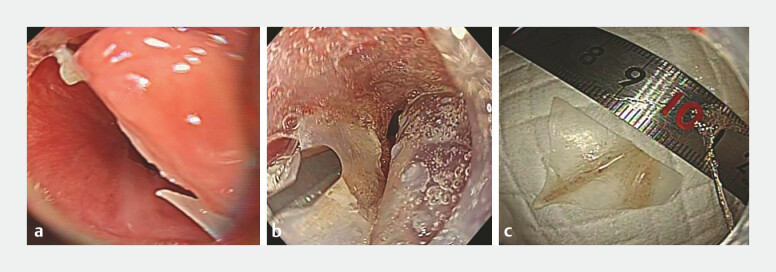 Fig. 2
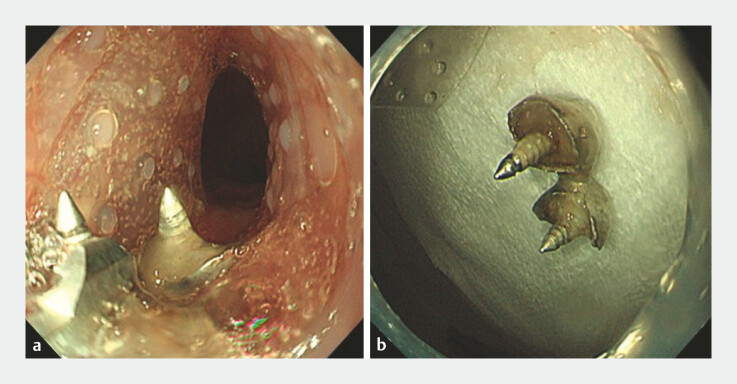 Fig. 3
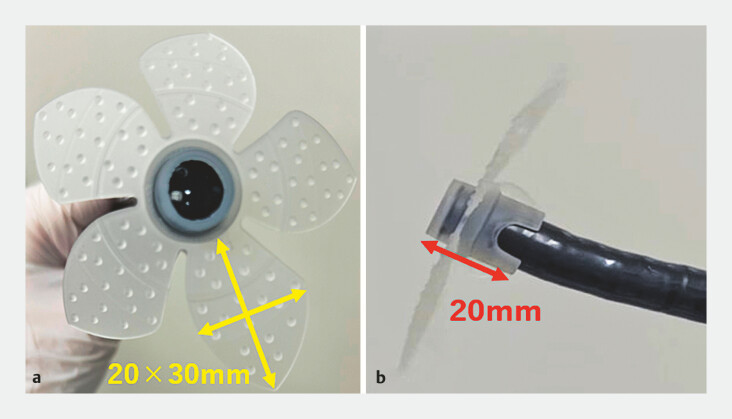 Fig. 4
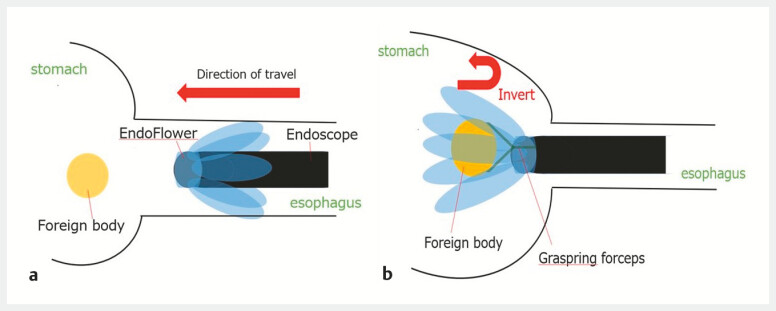 Fig. 5
Peer Reviews
No public reviews on file for this paper yet. If you reviewed it on a platform where reviews are public (OpenReview, ICLR, NeurIPS, ICML), you can paste yours below so the community can read it here.
Videos
No videos yet. Explain this paper in a talk, walkthrough, or lecture? Add one.
Taxonomy
TopicsForeign Body Medical Cases · Hemostasis and retained surgical items · Gastrointestinal Bleeding Diagnosis and Treatment
When performing the endoscopic retrieval of foreign bodies from the gastrointestinal tract, attaching a hood to the distal tip of the endoscope is necessary to ensure safe removal 1 2 3 . However, if a foreign body cannot be accommodated within the hood, the risk of gastrointestinal injury exists. Herein, we report a safe retrieval technique using a novel endoscopic distal attachment specifically designed for foreign body retrieval (EndoFlower; Fujifilm Medical Corporation, Tokyo, Japan).
Case 1 ( Fig. 1 ): A 75-year-old woman accidentally ingested a press-through package (PTP) sheet.
A case of accidental ingestion of a press-through package (PTP) sheet (Case 1). a An endoscopic image showing an impacted PTP sheet in the mid-esophagus. b Retrieval of the PTP sheet covered with the novel endoscopic distal attachment.
Case 2 ( Fig. 2 ): A 57-year-old woman accidentally ingested a fish-bone.
A case of accidental ingestion of a fish-bone (Case 2). a An endoscopic image showing a fish-bone impacted at the entrance of the esophagus. b Retrieval of the fish-bone covered with the novel endoscopic distal attachment. c Fish bones after collection.
Case 3 ( Fig. 3 ): A 92-year-old woman had accidentally ingested a denture.
A case of accidental ingestion of a denture (Case 3). a Retrieval of the denture covered with the novel endoscopic distal attachment. b Dentures after collection.
In all cases, the foreign body was successfully retrieved using an endoscope equipped with a novel attachment, without causing any gastrointestinal injury ( Video 1 ).
Safe retrieval of gastrointestinal foreign bodies using a novel endoscopic distal attachment.Video 1
The novel attachment is a dedicated foreign-body retrieval device composed of five silicone flaps in a flower-shaped design. This attachment has a total length of 20 mm and consists of five 20 × 30mm flaps ( Fig. 4 ). During endoscope insertion, the flaps are folded opposite to the direction of scope advancement to avoid obstructing the visual field. Although esophageal inversion of the flaps is sometimes possible, it was difficult in the present three cases; therefore, they were inverted in the stomach to envelop the foreign body ( Fig. 5 ).
Novel endoscopic distal attachment specifically designed for foreign body retrieval. a and b The attachment comprising five silicone, flower-shaped flaps. This attachment has a total length of 20 mm and consists of five 20 × 30 mm flaps.
A schematic diagram of EndoFlower. a Inserting of the EndoFlower. b Removal of foreign objects using EndoFlowers.
This attachment may be a safe and effective option for foreign body retrievals.
Endoscopy_UCTN_Code_CCL_1AB_2AF
The reference list from the paper itself. Each links out to its DOI / PubMed record.
- 1Birk M Bauerfeind P Deprez PH Removal of foreign bodies in the upper gastrointestinal tract in adults: European Society of Gastrointestinal Endoscopy (ESGE) Clinical Guideline Endoscopy 20164848949610.1055/s-0042-10045626862844 · doi ↗ · pubmed ↗
- 2ASGE Standards of Practice Committee Management of ingested foreign bodies and food impactions Gastrointest Endosc 2011731085109121628009 10.1016/j.gie.2010.11.010 · doi ↗ · pubmed ↗
- 3Demiroren K Management of Gastrointestinal Foreign Bodies with Brief Review of the Guidelines Pediatr Gastroenterol Hepatol Nutr 20232611436816435 10.5223/pghn.2023.26.1.1PMC 9911172 · doi ↗ · pubmed ↗