Correction: Methionine-Restricted C57BL/6J Mice Are Resistant to Diet-Induced Obesity and Insulin Resistance but Have Low Bone Density
Gene P. Ables, Carmen E. Perrone, David Orentreich, Norman Orentreich

Abstract
Genes, proteins, chemicals, diseases, species, mutations and cell lines named across the full text — each resolved to its canonical identifier and authoritative record.
Click any figure to enlarge with its caption.
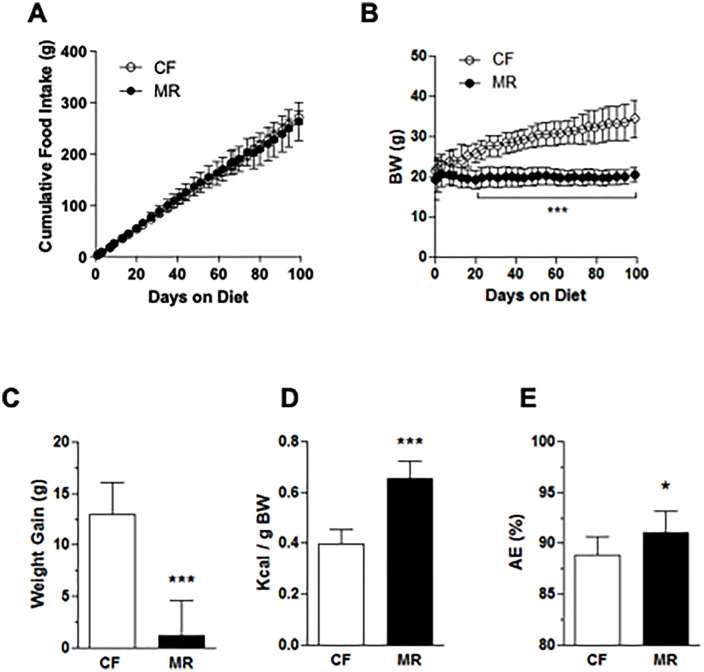 Figure 1
Peer Reviews
No public reviews on file for this paper yet. If you reviewed it on a platform where reviews are public (OpenReview, ICLR, NeurIPS, ICML), you can paste yours below so the community can read it here.
Videos
No videos yet. Explain this paper in a talk, walkthrough, or lecture? Add one.
Taxonomy
TopicsCancer Research and Treatments · Folate and B Vitamins Research · Biochemical effects in animals
There is an error in the Figs 1 and S1. The panel A is incorrect. The range of the y-axis should have not been “0-100” but “0-400”. Please see the correct Figs 1 and S1 here.
Supporting information
S1 FigMR mice on LFD have lower body weight gain despite increased energy intake.(A) Cumulative food intake was measured on LFD mice twice a week for 99 days. (B) Body weights (BW) were measured on HFD mice twice a week for 99 days. (C) Body weight gain was the difference between the weights at the beginning and at the end of the study. (D) Energy intake was calculated based on the average daily energy (kcal) intake per gram body weight. (E) Absorption efficiency was estimated based on the amount of food intake and fecal output within a 24 h period as described in the Methods section. Data is presented as the mean ± SD of 8 mice per treatment group and analyzed by Two-way ANOVA followed by Bonferroni post-tests (A and B) or Student’s unpaired t-test (C–E). *p < 0.05, ***p < 0.001.(TIFF)
The reference list from the paper itself. Each links out to its DOI / PubMed record.