Correction: Exploring the potential of nest archives for establishing long-term trends in local populations of an Arctic-nesting colonial sea duck
Inmaculada Álvarez-Manzaneda, Kathleen M. Rühland, Marlo Campbell, Matthew P. Duda, Mark L. Mallory, Nik Clyde, H. Grant Gilchrist, Kathryn E. Hargan, John P. Smol

Abstract
Genes, proteins, chemicals, diseases, species, mutations and cell lines named across the full text — each resolved to its canonical identifier and authoritative record.
Click any figure to enlarge with its caption.
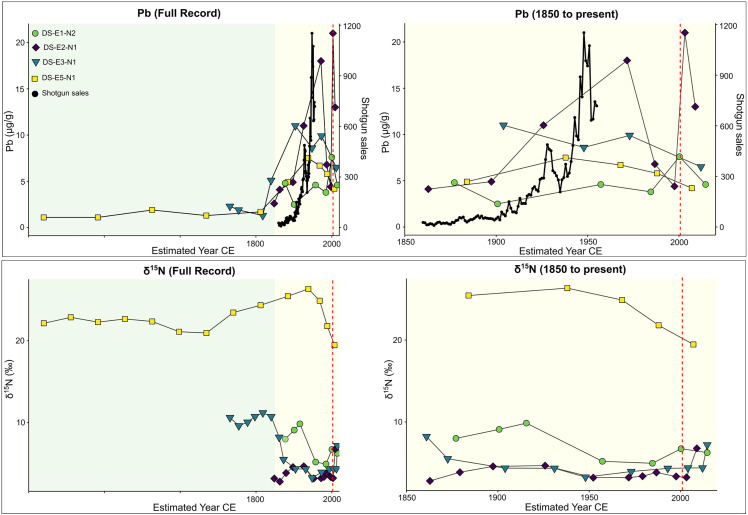 Figure 1
Peer Reviews
No public reviews on file for this paper yet. If you reviewed it on a platform where reviews are public (OpenReview, ICLR, NeurIPS, ICML), you can paste yours below so the community can read it here.
Videos
No videos yet. Explain this paper in a talk, walkthrough, or lecture? Add one.
Taxonomy
TopicsAvian ecology and behavior · Genetic diversity and population structure · Livestock and Poultry Management
The last two sentences of Fig 9 caption should be ommited. Please see the complete, correct Fig 9 caption here.
In the Radioisotopic dating (210Pb and 14C) subsection of the Materials and methods, there is an error in the eighth and ninth sentences of the first paragraph. The correct sentences are: The chronologies for the nest profiles were based on estimates of unsupported 210Pb activities and the constant rate of supply (CRS) model [35], using the ScienTissiME dating software (http://www.scientissime.net/software). The CRS model is widely used for dating recent sediment profiles [34,35] and assumes a constant supply of unsupported 210Pb deposited from the atmosphere to the surface of vertically aggrading profiles, while allowing for variations in accumulation rates [35].
In the Radioisotopic dating (210Pb and 14C) subsection of the Results, there is an error in the first sentence of the second paragraph. The correct sentences are: Establishing chronologies for the nest profiles DS-E5-N1 and DS-E3-N1 entailed combining 210Pb and 14C dating results, as the bottom intervals of these nests lie beyond the maximum range possible for obtaining reliable dates using 210Pb (~150 years) methods but were within the upper range of 14C methods.
The Data Availability statement for this article is incorrect. The correct statement is: All data, figures and scripts used in the manuscript are uploaded to Zenodo. The DOI is: https://doi.org/10.5281/zenodo.15526799.
The reference list from the paper itself. Each links out to its DOI / PubMed record.
- 1Álvarez-Manzaneda I, Rühland KM, Campbell M, Duda MP, Mallory ML, Clyde N, et al. Exploring the potential of nest archives for establishing long-term trends in local populations of an Arctic-nesting colonial sea duck. P Lo S One. 2025;20(10):e 0332605. doi: 10.1371/journal.pone.0332605 41071766 PMC 12513636 · doi ↗ · pubmed ↗